In 1985, Dr. Michael Thompson and Dr. Reinhard Förster collected a fossilized vertebrae during an expedition to Antarctica. In his notebook, Thompson wrote, “Vertebrae of large reptile. Neural arch broken. ~10 cm diameter,” and included a small sketch of the fossil.
The expedition aimed to characterize Antarctica’s rock layers, to aid the dating of discovered fossils during future expeditions. However following the expedition, the fossilized bone was tucked away into storage archives belonging to the British Antarctic Survey (BAS).
Over 40 years later, Antarctica’s first-discovered dinosaur bone was finally formally described.
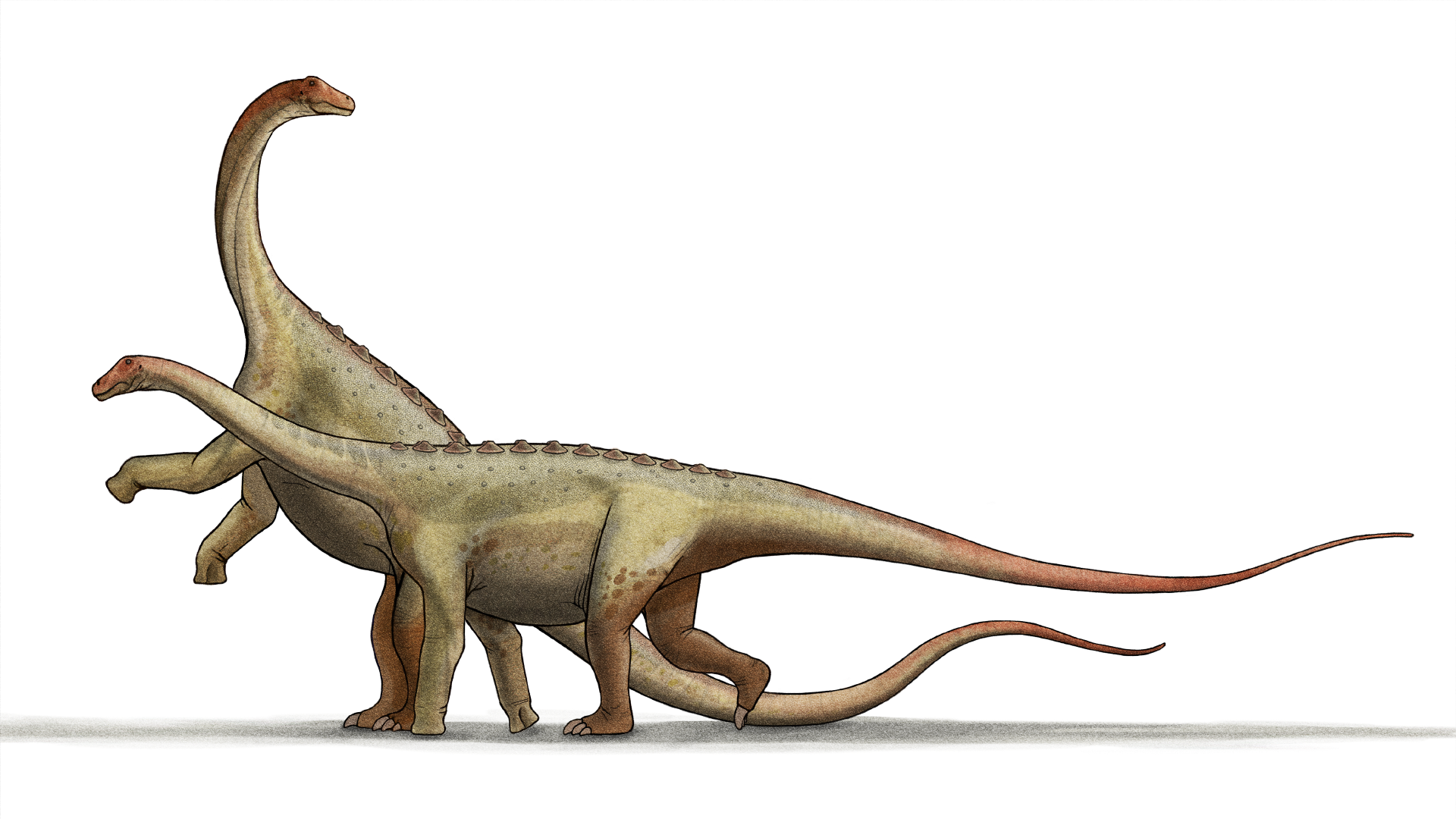
An illustration of Adamantisaurus mezzalirai, a titanosaurian sauropod similar to the Antarctic lithostrotian titanosaur. Adamantisaurus is found in modern South America. Karkemish, CC BY-SA 3.0 <https://creativecommons.org/licenses/by-sa/3.0>, via Wikimedia Commons.
While more dinosaur fossils have been found in Antarctica since, this specimen remained unexamined. That is, until Dr. Mark Evans, a paleontologist and manager of the BAS geological collection, decided to take a closer look.
Due to the size of the vertebrae, the researcher team believe the fossil to be from a juvenile or small-bodied adult sauropod, a long-necked herbivorous dinosaur.
Antarctica is currently covered in ice. Today’s thick, continent-spanning ice sheets likely restrict researcher’s ability to find fossils, limiting our understanding of what an ancient Antarctica looked like. Naturally, the region has produced the lowest number of dinosaur fossils of any continent. There is likely much left undiscovered, whether under the ice or hidden in the drawers of an archive.
While fossils from several other species have been found in Antarctica, the BAS specimen is the second published record of sauropods in Antarctica.


Wow! Interesting that it took so long to evaluate such a defining find. JT