
Shark Friendships? New Research Uncovers Social Dynamics of Bull Sharks
New research published in Animal Behavior in April 2026 indicates that bull sharks are able to form intricate social networks and bonds with other bull sharks.
In the novel Jaws, Peter Benchley writes, “Sharks have everything a scientist dreams of. They’re beautiful―God, how beautiful they are! They’re like an impossibly perfect piece of machinery…No one knows for sure how long they live or what impulses―except for hunger―they respond to.”
Now we know that alongside hunger, they also respond to the innate impulse for friendship that drives us all.
Jaws framed sharks as mindless killers, only having the urge to feed and destroy. Bull sharks in particular have a reputation for aggressive behavior. However, this new research uncovers a softer side of these fearsome predators.
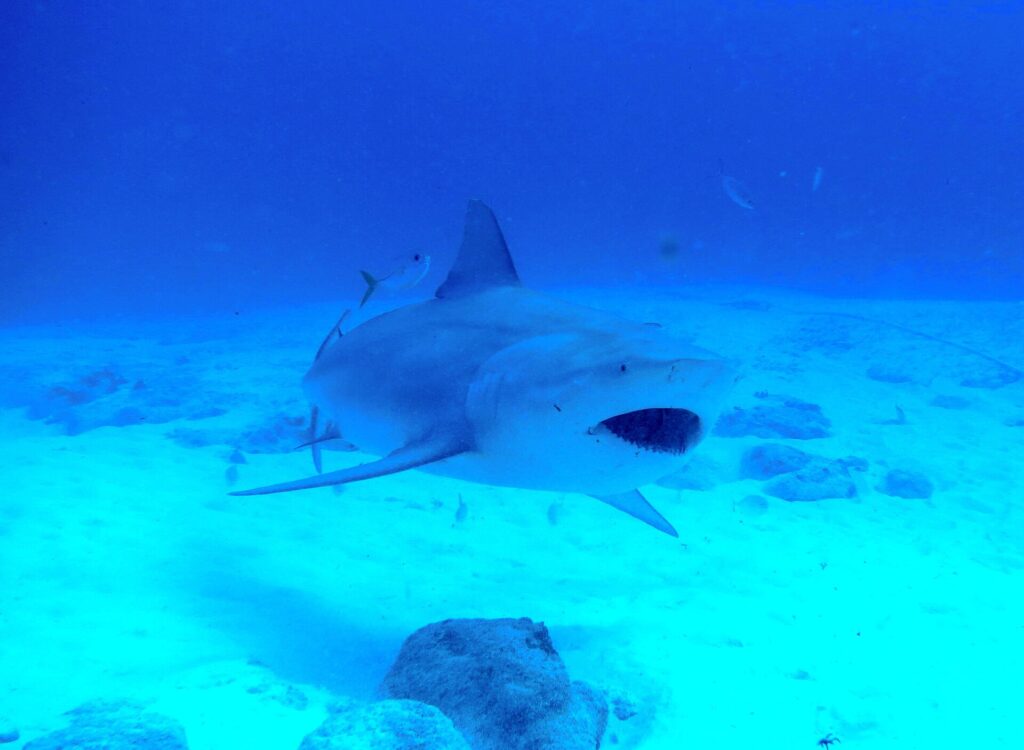
Smile for the camera! A bull shark photographed off the coast of Mexico. Jerome Paillet (IFREMER, Laboratoire d’Océanographie Physique et Spatiale, Centre Bretagne – ZI de la Pointe du Diable – CS 10070 – 29280 Plouzané), CC BY 4.0 <https://creativecommons.org/licenses/by/4.0>, via Wikimedia Commons.
Lead author Natasha D. Marosi states, “As humans we cultivate a range of social relationships―from casual acquaintances to our best friends, but we also actively avoid certain people―and these bull sharks are doing similar things.”
Membership in social groups can increase an individual’s access to resources, potential mates, and information, while simultaneously reducing predation risk. However, not all intraspecific (within the same species) aggregations result in coherent social interactions or the formation of social groups.
The study, which utilized six years of observations on 184 bull shark individuals, determined that the observed grouping patterns are driven by active social preferences and interactions. Individual sharks had preferred, occasional, and avoided social partners, and these selective interactions drove social bonds and networks within the population.
The study site was the Shark Reef Marine Reserve located off of Viti Levu Island. This region is designated as a shark sanctuary, and one operator conducts shark dives in the area. The operator provisions the sharks with tuna, and this reliable and low-effort food source has driven shark aggregations in the region.
It is worth noting that shark baiting is controversial, and may cause behavioral changes. However in Fiji, provisioning seems to only have minor effects on bull shark behavior. Other research from Fiji indicates that the provisioning of high-calorie bait may have positive impacts on the bull sharks’ health. In this case, the existence of the bull shark aggregation enables extensive research on the species without appearing to have significant detrimental impacts on the sharks.
Influence of sex:
Most sharks at the site were female (~85%). Female bull sharks are larger than males, and may rank higher in the dominance hierarchy as a result.
Both male and female bull sharks preferred to associate with female sharks. However, males held more central positions in the social network than females. Males also had more social connections than females.
In the paper, the researchers suggest that male sharks at this site might have bolder personalities. Male sharks may go out of their way to socialize with the females to avoid being excluded from the aggregation and continue to maintain access to the food source.
Influence of age:
The sharks were divided into three age groups: sub-adults, adults, and advanced adults.
Adults formed the strongest associations within their own age group. Sub-adults and advanced adults only weakly associated within their own age class. Both sub-adults and advanced adults had a slightly stronger tendency to associate with the adult sub-class, compared to their own age classes.
Advanced adults were the least socially connected group. Older sharks still rank highly in the dominance hierarchy, but are often asocial or socially withdrawn. They may focus more on self-reliance. Throughout their longer lives, advanced adults may have developed strong survival skills, resulting in less reliance on social bonds to survive.
Physical and mental decline corresponding to age could also explain observed social withdrawal trends among advanced adults.
Sub-adults may be excluded due to their low ranking within the dominance hierarchy. However, similar to how males associate with females, bold sub-adults associate or socially interact with adults.
The researchers noted sub-adults following, observing, and then mimicking adult sharks. This enables social learning among younger individuals. However, few sub-adults are present within the population.

Bull sharks in Fiji. amanderson2, CC BY 2.0 <https://creativecommons.org/licenses/by/2.0>, via Wikimedia Commons.
Ultimately, understanding social behavior is important in an ecological and conservation context. The social behavior observed in the Shark Reef Marine Reserve likely improves the overall fitness of the population through improved social learning, cooperation, and information transfer. Framing this understanding within the greater context of conservation and management strategies may enhance our ability to protect these animals.


_(Ifremer_00813-92510_-_53587).jpg)
