Species Spotlight: Spotted Ratfish
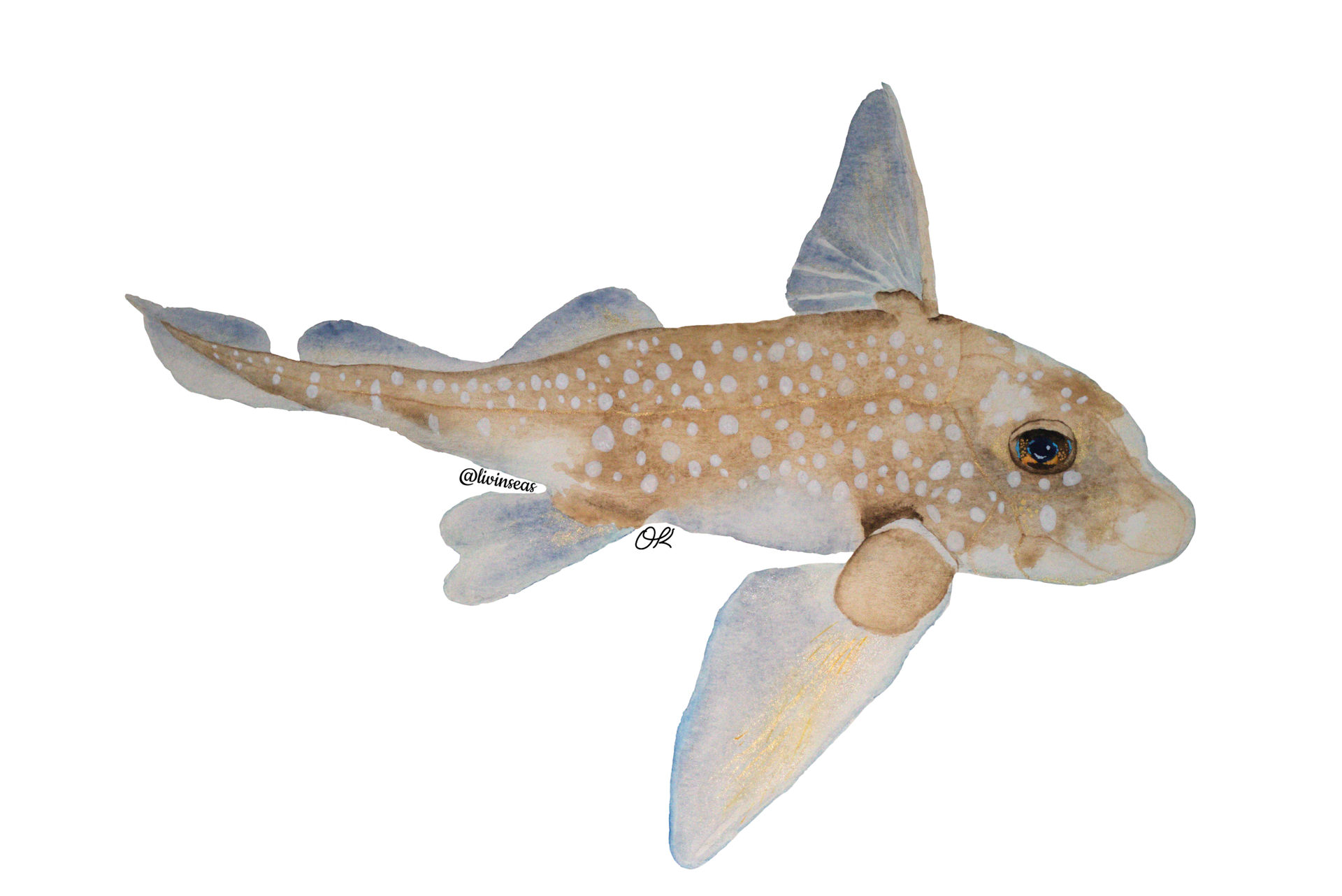
The spotted ratfish (Hydrolagus colliei) is an adorable chimaera. It features charismatic white spots and a cute, almost cartoon-like rostrum. Chimaeras (Order: Chimaeriformes) are cartilaginous fish related to sharks, skates, and rays. Similar to these groups, their phylogeny is ancient, dating back hundreds of millions of years.
The species has been rated by the IUCN as Least Concern. They are abundant throughout their range, which stretches from the central Gulf of Alaska to Costa Rica. They are most commonly found living near the seafloor in both shallow and deep waters (maximum depth: 1463 meters/4800 feet).

Watercolor painting of a Spotted Ratfish (H. colliei) by me. ©LivInSeas, 2025
Morphology – Size:
Males are smaller than females, maturing between 30 and 35 centimeters (11.8 – 13.8 inches). Females mature between 40 and 45 centimeters (15.8 – 17.7 inches).
Individuals in northern regions of the range are larger than those in the south. Differences in size distributions are likely due to lower temperatures and higher food availability in the north. However, several other factors could contribute to a latitudinal size gradient. These include discrete, regional breeding populations and differences in fishing intensity across the range, although the latter is an untested hypothesis.
Reproduction:
Spotted ratfish are oviparous. Oviparity refers to the laying of undeveloped eggs instead of live young.
Chimaeras lay one or two eggs at a time, and gestation is estimated to last nine to twelve months. Egg deposition occurs year-round, but it reaches a peak in late summer/early fall in California and summer in Washington state.
Venom:
Spotted ratfish have a mildly venomous dorsal spine, located ahead of their dorsal fin. In fish, venom apparatuses are generally comprised of venom glands on either side of a sharp spine covered with a layer of skin.
While they are mildly venomous, the sharp spine itself may pose a greater danger to potential predators than the venom itself. The spine could puncture the esophagus or digestive tract of a predator. However, early twentieth-century fishermen reported being more concerned about the ratfish’s jaws than their spines and venom, fearing the chimaera’s strong bite.

Spotted ratfish (Hydrolagus colliei) observed off Pt Pinos during a sanctuary seafloor monitoring survey. Linda Snook / MBNMS, Public domain, via Wikimedia Commons.
Electroreception:
Chimaeras, like sharks, skates, and rays, possess specialized pores on their rostrum, or their snout. These pores are used to detect electricity released by potential prey.
Electric charges are generated by muscular movement in living organisms. These charges interact with seawater and create a weak voltage. The chimaeras then use their specialized pores to detect this emitted voltage.
Aquatic Flight Movement Pattern:
Aquatic flight is the primary locomotive mode for spotted ratfish, as well as several other groups like penguins and turtles. While their shark relatives generate thrust with their caudal fin, spotted ratfish flap their pectoral fins to generate thrust. These chimaeras have well-developed pectoral muscles, indicating that they use their pectoral fins to “fly” through the water.
Certain morphological and kinematic characteristics show that spotted ratfish prioritize high maneuverability and the generation of lift. Interestingly, spotted ratfish move their pectoral fins in an ovular shape, rather than the figure-8 shape common to other organisms who move via aquatic flight. The downstroke of their movements is faster than the upstroke, which generates additional lift.
The distal, or far end, of the pectoral muscle is also well-developed. This indicates that spotted ratfish have fine control over the movement of the fin. As such, spotted ratfish are able to navigate a complex, seafloor environment.
Population Dynamics:
Spotted ratfish are ecologically important due to their high abundance and role in the ecosystem as both predator and prey. They are not fished for directly. However, they are caught as bycatch, and survival rates of discarded individuals are low.
Currently, their vulnerability to fishing activity is not fully understood. Methods for determining age in chimaeroids are limited and unreliable. An understanding of fish age and growth patterns is necessary for the development of informed conservation and management strategies. As a result, the effectiveness of certain age-based methods of population analysis is limited.
In addition, fisheries-dependent data on spotted ratfish is lacking. Fisheries-dependent data refers to data collected from commercial fishing efforts. Non-target species caught as bycatch, like the spotted ratfish, are generally not recorded within commercial fisheries landing data.
Fisheries-independent data refers to data collected from scientific research surveys. These surveys are not associated with commercial fishing efforts, even if they use similar methods to commercial fishing. Following a review of fishery-independent surveys, researchers determined that spotted ratfish populations have significantly increased over time (data published in 2012). While oceanographic factors may play a role, the observed population growth may also be a result of successful fisheries management policies.
The trend could be attributed to reductions in groundfish quotas in commercial fisheries beginning in the 1990’s. These closures were intended to protect vulnerable rockfish populations, but many rockfish species have not yet recovered to the same extent as spotted ratfish.
Regardless of the exact cause, the observed population growth shows that marine populations are able to recover even after periods of increased mortality. This effect is especially impressive when observed within species with low fecundity/reproductive rates, like spotted ratfish.
Scientists have also observed aggregations of juveniles and egg cases at shelf breaks, before steeper slopes into deep waters. The tendency to aggregate by age class may also leave the species vulnerable to fishing activity, in addition to their low fecundity rates.
Pin this post to read later!
References:
- Barnett, L. A. (2008). Life history, abundance, and distribution of the spotted ratfish, Hydrolagus colliei.
- Barnett, L. A., Earley, R. L., Ebert, D. A., & Cailliet, G. M. (2009). Maturity, fecundity, and reproductive cycle of the spotted ratfish, Hydrolagus colliei. Marine Biology, 156(3), 301-316.
- Barnett, L. A. K., Ebert, D. A., & Cailliet, G. M. (2009). Assessment of the dorsal fin spine for chimaeroid (Holocephali: Chimaeriformes) age estimation. Journal of Fish Biology, 75(6), 1258-1270.
- Barnett, L. A. K., Ebert, D. A., & Cailliet, G. M. (2012). Evidence of stability in a chondrichthyan population: case study of the spotted ratfish Hydrolagus colliei (Chondrichthyes: Chimaeridae). Journal of Fish Biology, 80(5), 1765-1788.
- Carrier, J. C., Simpfendorfer, C. A., Heithaus, M. R., & Yopak, K. E. (Eds.). (2022). Biology of sharks and their relatives.
- Fields, R. D., & Lange, G. D. (1980). Electroreception in the ratfish (Hydrolagus colliei). Science, 207(4430), 547-548.
- Finucci, B., Ebert, D.A., Didier, D. & Rohner, C.A. 2024. Hydrolagus colliei. The IUCN Red List of Threatened Species 2024: e.T60191A124449845. https://dx.doi.org/10.2305/IUCN.UK.2024-2.RLTS.T60191A124449845.en.
- Foster, K. L., & Higham, T. E. (2010). How to build a pectoral fin: functional morphology and steady swimming kinematics of the spotted ratfish (Hydrolagus colliei). Canadian journal of zoology, 88(8), 774-780.
- Halstead, B. W., & Bunker, N. C. (1952). The venom apparatus of the ratfish, Hydrolagus colliei. Copeia, 1952(3), 128-138.
- Labmate Online (n.d.). What is Electroreception, and How Do Sharks Use It to Hunt? https://www.labmate-online.com/news/news-and-views/5/breaking-news/what-is-electroreception-and-how-do-sharks-use-it-to-hunt/39409
- Mecklenburg, C.W., T.A. Mecklenburg and L.K. Thorsteinson, 2002. Fishes of Alaska. American Fisheries Society, Bethesda, Maryland. xxxvii +1037 p
- Ziegman, R., & Alewood, P. (2015). Bioactive components in fish venoms. Toxins, 7(5), 1497-1531.