Species Spotlight: Hummingbird Bobtail Squid
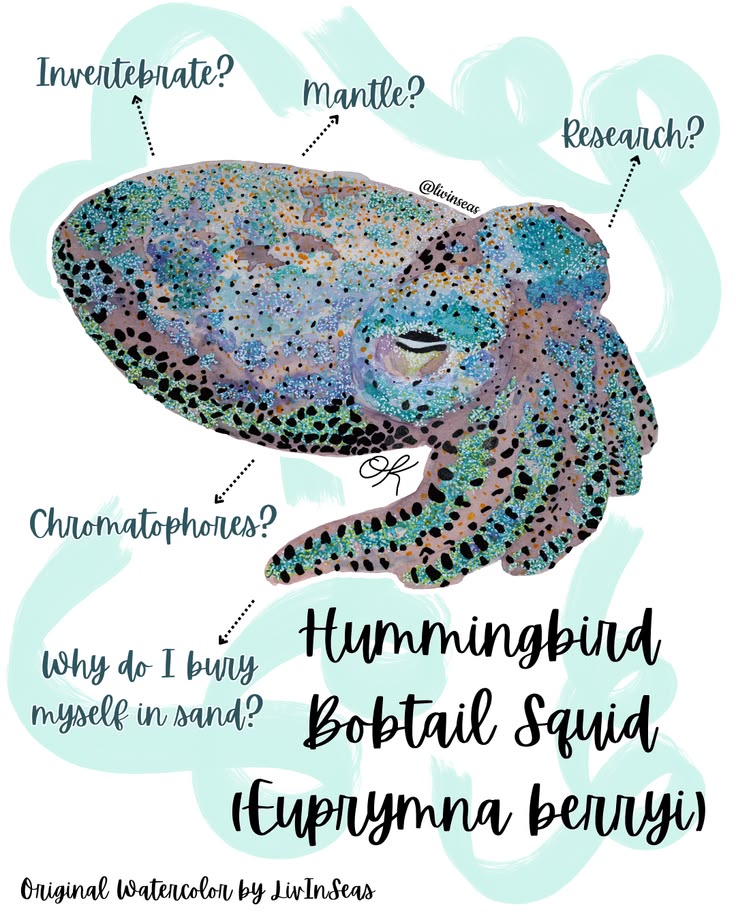
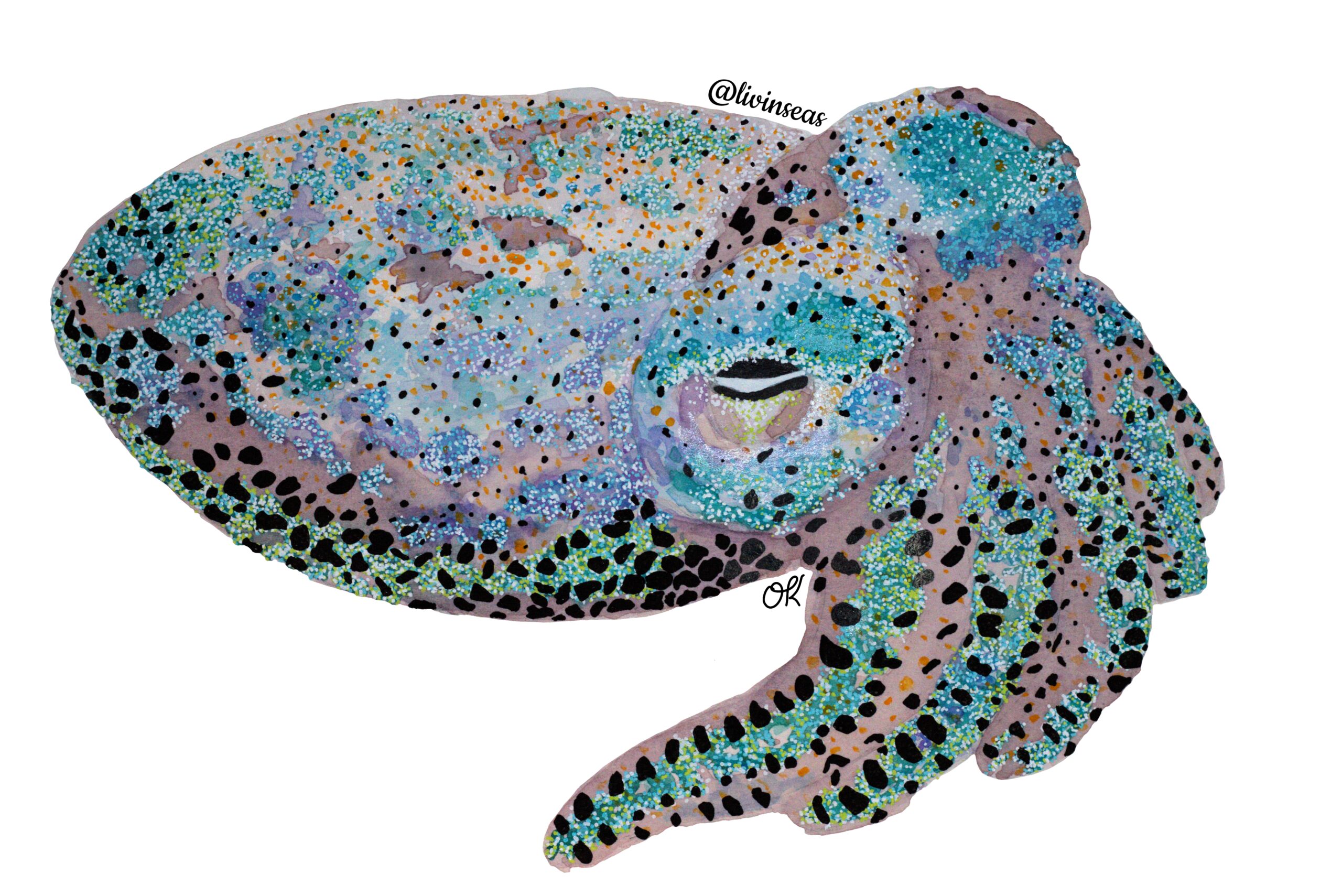
The tiny hummingbird bobtail squid (Euprymna berryi) is a visually-striking cephalopod. It features a bright, fluorescent coloration and dark chromatophores. While often mistaken for cuttlefish, the notoriously adorable bobtail squid are classified within their own phylogenetic order. And, they lack the distinctive cuttlebone characteristic to cuttlefish.
My source of inspiration for this watercolor painting I created for my LivInSeas platforms came from a TikTok! In this video, a cute little hummingbird bobtail squid was using its teeny, tiny arms to shove comparatively large grains of sand over its body so it could bury itself.

Water color painting of a Hummingbird Bobtail Squid (E. berryi) by me. ©LivInSeas, 2025
Cephalopods are invertebrates, which means they lack a vertebral column. Other invertebrates, such as jellyfish, insects, and sponges, are not exactly known for their cerebral prowess. However, cephalopods are extremely intelligent and have a highly-complex nervous system, well-developed senses, and large brains. This has given cephalopods special legal recognition as sentient beings.
Range & Habitat:
E. berryi is native to tropical waters in the central Indo-Pacific, ranging mainly from Indonesia to southern Japan and China.
It lives in coastal, benthic habitats and prefers fine and sandy sediments. During the day, the squid will bury themselves in the sand to avoid predators. They emerge at night to feed or mate with other hummingbird bobtail squid.
E. berryi are found in shallow waters down to 107 meters (351 feet).

A hummingbird bobtail squid buried in the sand. Kai Squires, CC BY 4.0 <https://creativecommons.org/licenses/by/4.0>, via Wikimedia Commons.
Morphology:
Squid are measured by mantle length, which refers to their upper body cavity. The mantle houses the squid’s organs. Squids intake water into the mantle over their gills, then expel it through their siphon, which can be directed directionally.
Males of the species are smaller than females. The mantle length of males measures up to three centimeters (roughly 1.2 inches), while females mantle lengths can measure up to five centimeters (roughly two inches).

An annotated image depicting external measurements of a squid, including the organ-housing mantle. Michael Vecchione, Clyde F.E. Roper, & Michael J. Sweeney, Public domain, via Wikimedia Commons.
E. berryi have chromatophores, or neuromuscular organs located within the skin. They’re comprised of one pigment-containing cell surrounded by radial muscles which control expansion and contraction of the cell. Chromatophores help the squid disguise from being spotted by predators through camouflage and for communication with other hummingbird bobtail squids. The cells are controlled neurally and can be opened within milliseconds.
Vertebrate predators hunt by looking for visual edges or breaks in the background. Using chromatophores to match background textures allows cephalopods to blend in. This is referred to as crypsis.
Typically, chromatophore pigments are black, red, yellow, or brown. Additional colors can be obtained with reflective cells called iridophores.
Interestingly, cephalopods are believed to be colorblind.
Bobtail Squid as Model Species:
It is difficult to study cephalopods in a laboratory setting due to behavioral complexities, difficulties obtaining multi-generational cultures, and frequent feeding requirements. As such, cephalopod research is limited.
Members of a bobtail squid subfamily Sepiolinae, including Euprymna berryi, are particularly suitable in laboratory settings. The squid are small and have limited nutritional requirements, which is ideal for an aquaria setting. They also have short lifespans and reproduce in captivity. This makes them well-suited for studies which span multiple generations of squid. Sepiolinae squid also do not have cannibalistic tendencies, which allows them to be housed together.
One study (Putland et al., 2013) conducted on E. berryi has found that their behavior and physiology are significantly altered when exposed to vessel noise, even up to several hours following exposure. Anthropogenic influence, or disturbance caused by humans to the environment, is a significant threat to marine ecosystems globally. This includes human-created sounds, which continue to grow louder and more widespread throughout our oceans.
Through studies like these, we are better able to understand our impacts on the natural world and strengthen the scientific body of literature surrounding these issues. Strong, science-based evidence can then be used to shape legislation and management practices to protect our oceans. Even the tiniest squids can have the biggest impact!
Pin this post to read later!