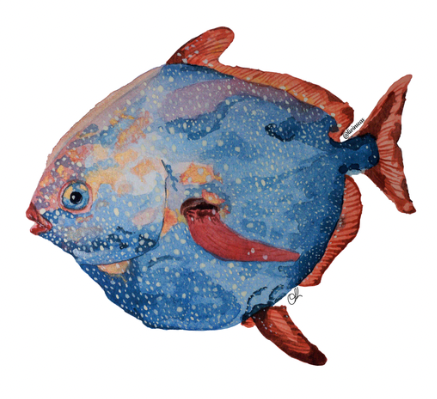

Species Spotlight: Strawberry Squid
In the dark of the deep sea, a pint-sized predator flaps its fins, drifting through the darkness. It points its one, enlarged yellow eye upward and stares down into the abyss below with its small blue eye. At night, it will chase its prey into shallower waters, participating in the biggest migration on earth. This is the strawberry squid (Histioteuthis heteropsis).
The strawberry squid is a flashy, important member of the pelagic food web. It acts as an intermediate predator, which many top predators of the deep rely on for sustenance.

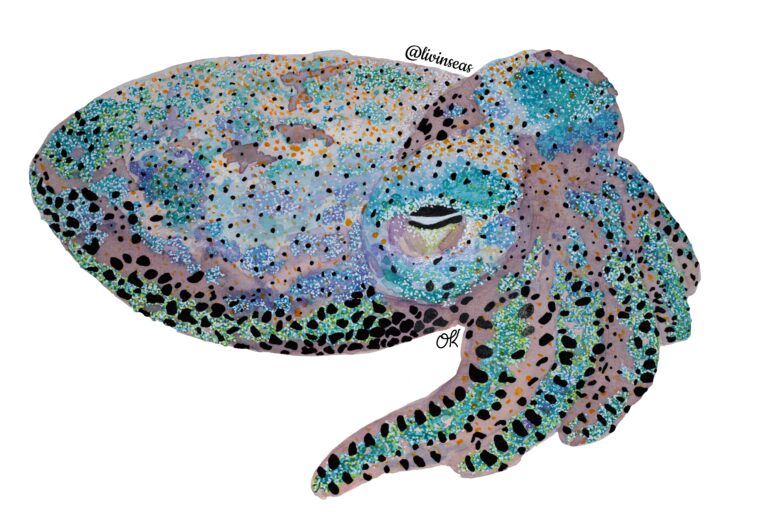
Water color painting of a Strawberry Squid (H. heteropsis) by me. ©LivInSeas, 2025
Range:
The strawberry squid is found in the northeast and southeast Pacific Ocean. It is absent in equatorial waters. As a result, two distinct populations of the squid exist off of the west coasts of North and South America, restricted to the California and Humboldt currents respectively.
The species is not thought to undergo horizontal migration across distance. Despite this, the two populations still appear to be remarkably similar.
Habitat:
In the northeastern Pacific, the strawberry squid can be found at depths between 300-800 meters (985-2625 feet) during the day. This range falls within the mesopelagic zone, where light vanishes and oceanic conditions (e.g. temperature, salinity) rapidly change.
At night, the squids migrate upwards to depths between 0-400 meters (0-1310 feet). This is referred to as diurnal (or diel) vertical migration (DVM). At night, many creatures of the deep undergo a long swim towards food-rich surface waters to feed. In the dark waters, they are hidden from predators who require light to detect prey.
The Greatest Migration:
Billions of animals globally participate in vertical migration on a daily basis. It is referred to as “the greatest migration on Earth.”
During the day, primary producers in surface waters experienced reduced predation pressure, and can fix carbon and multiply more easily. After creatures from the deep feed on surface organisms and return to the darkness, they produce waste at depth. This enhances the rate at which carbon is transported to the ocean floor and sequestered away from the atmosphere.
Morphology:
The strawberry squid has purplish-red skin. Males are smaller than females of the species. Males’ mantles measure up to 9 centimeters (roughly 3.5 inches), while females’ mantles measure up to 13 centimeters (roughly 5.1 inches).

An annotated image depicting external measurements of a squid, including the organ-housing mantle. Michael Vecchione, Clyde F.E. Roper, & Michael J. Sweeney, Public domain, via Wikimedia Commons.
Strawberry squid have eyes of two different colors and sizes (referred to as dimorphic). The species name “heteropsis” translates to “different eyes”.
As larvae, their eyes are the same size. During juvenile development, the squid’s left eye enlarges, forming a tubular shape. The left eye is able too move independently. The eye’s yellow lens enhances the squid’s ability to differentiate between downwelling sunlight and light radiating from bioluminescent camouflage. This allows the squid to see through counter-illumination camouflage.
The smaller blue eye of the strawberry squid specializes in detecting bioluminescence from below. It has a broad field of view, which allows the squid to monitor a large volume of water for flashing bioluminescence of other organisms.
The strawberry squid orients itself so the large, yellow eye points upwards towards the surface, and the small, blue eye points downwards towards the abyss.
Strawberry squid have a large number of photophores found across the surface of their body. Photophores are light-emitting organs, which are the organs responsible for bioluminescence. The photophores covering the squid’s body look almost jewel-like, giving it a striking appearance.
In cephalopods, photophores are responsible for counter-shading, predation tactics, or communication with other members of the same species. Counter shading refers to when organisms have a lighter appearance on their lower side. When organisms in deeper waters see them from below, this appearance mimics light from the surface.
Role in the Food Web:
The strawberry squid is a mid-level predator. They eat smaller species, but are consumed by larger species. Their abundance in the ocean serves as an important food source for high-level predators.
The squids are preyed upon by a variety of species–fish, birds, and mammals alike. These including blue sharks, swordfish, northern fulmars, northern elephant seals, and crocodile sharks.
Adult members of the histioteuthid genus eat counterilluminating organisms like shrimp, lanternfish, and other cephalopods.
Every step in the food web is crucial to maintaining a functioning ecosystem. Mid-level predators like the strawberry squid move energy up the food chain to top predators, while also controlling the populations of lower-level organisms. Preventing lower-level organisms from overpopulating protects photosynthesizers from over-grazing, enabling the continuation of food production in the ecosystem.
Pin this post to read later!

References:
- Antonelis, G. A., Lowry, M. S., Fiscus, C. H., Stewart, B. S., & DeLong, R. L. (1994). Diet of the northern elephant seal. Elephant seals: population ecology, behavior, and physiology, 211-223.
- Barratt, I. & Allcock, L. 2014. Histioteuthis heteropsis. The IUCN Red List of Threatened Species 2014: e.T162925A953880. https://dx.doi.org/10.2305/IUCN.UK.2014-1.RLTS.T162925A953880.en.
- Calle-Morán, M.D., A.R. Hernández-Téllez, E.R. Tibán-Vivar, Y.E. Intriago-Vera, I.G. Del Valle-Coello, B.C. Loor-Jama and Á.R. Ganchozo-López 2022 Diet composition and feeding habits of the crocodile shark, Pseudocarcharias kamoharai. Environ. Biol. Fishes 105:685-697.
- Hills, S., & Fiscus, C. H. (1988). Cephalopod beaks from the stomachs of northern fulmars (Fulmarus glacialis) found dead on the Washington coast. The Murrelet, 15-20.
- Markaida, U. and O. Sosa-Nishizaki 1998 Food and feeding habits of swordfish, Xiphias gladius L., off western Baja California. NOAA Tech. Rep. NMFS 142:245-259.
- Nishizaki, S. Food and feeding habits of the blue shark Prionace glauca caught off Ensenada, Baja California, Mexico, with a review on its feeding.
- Roper, C. F. E.; Jereb, P. (2010). Family Histioteuthidae. In: P. Jereb & C.F.E. Roper, eds. Cephalopods of the world. An annotated and illustrated catalogue of species known to date. Volume 2. Myopsid and Oegopsid Squids. FAO Species Catalogue for Fishery Purposes. No. 4, Vol. 2. Rome, FAO. pp. 223-236., available online at http://www.fao.org/docrep/014/i1920e/i1920e.pdf
- Thomas, K. N., Robison, B. H., & Johnsen, S. (2017). Two eyes for two purposes: in situ evidence for asymmetric vision in the cockeyed squids Histioteuthis heteropsis and Stigmatoteuthis dofleini. Philosophical Transactions of the Royal Society B: Biological Sciences, 372(1717), 20160069.
- Tricas, T.C. 1979 Relationships of the blue shark, Prionace glauca, and its prey species near Santa Catalina Island, California. Fish. Bull. 77(1):175-182.
- Voss, N. A. (1969). Biological investigations of the deep sea. 47. A monograph of the Cephalopoda of the North Atlantic. The family Histioteuthidae. Bulletin of marine science, 19(4), 713-867.
- Voss, N. A., Nesis, K. N., & Rodhouse, P. G. (1998). The cephalopod family Histioteuthidae (Oegopsida): systematics, biology, and biogeography. Smithsonian Contributions to Zoology, 293-372.
- WoRMS Editorial Board (2025). World Register of Marine Species. Available from https://www.marinespecies.org at VLIZ. doi:10.14284/170