
Phytoplankton: Earth’s Unsung Heroes
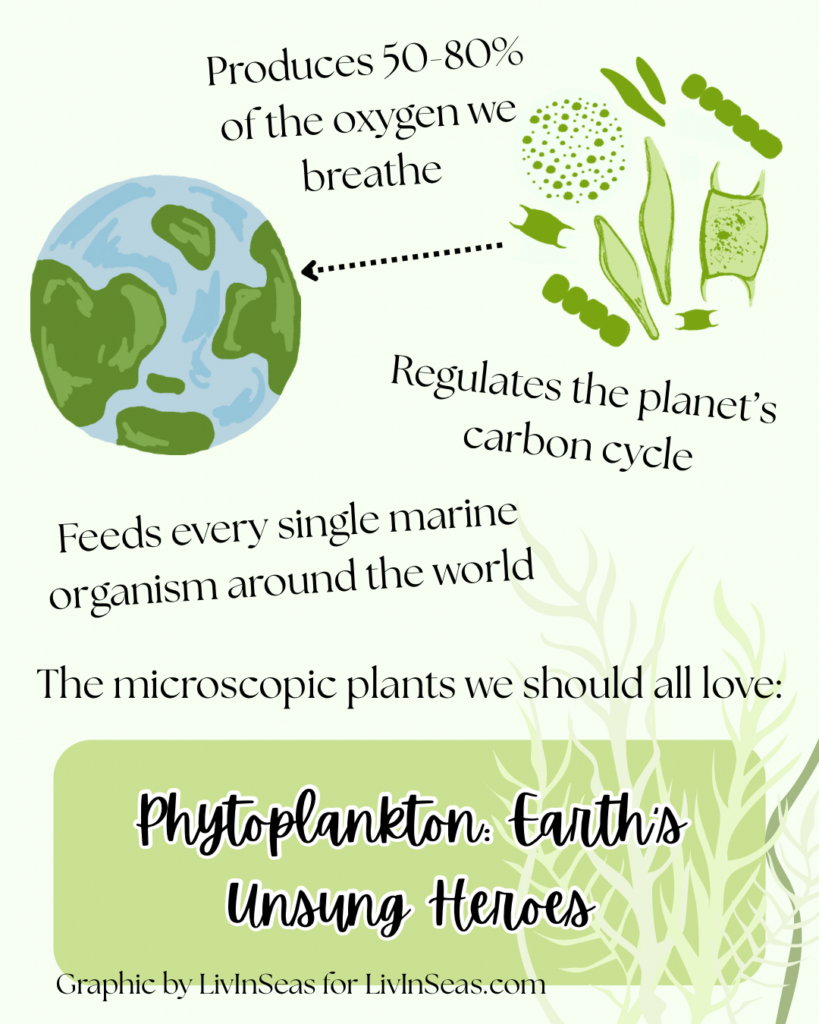
What if I told you that anywhere between 50-80% of the oxygen in our atmosphere came from organisms that you can’t even see? Microscopic marine plants are one of the most important groups on the entire planet for ensuring terrestrial life can thrive. But, few people are actually aware of their vast impact on our atmosphere, which includes both oxygen production and carbon sequestration.
Rainforests, who? Meet the real lungs of our planet: Phytoplankton.
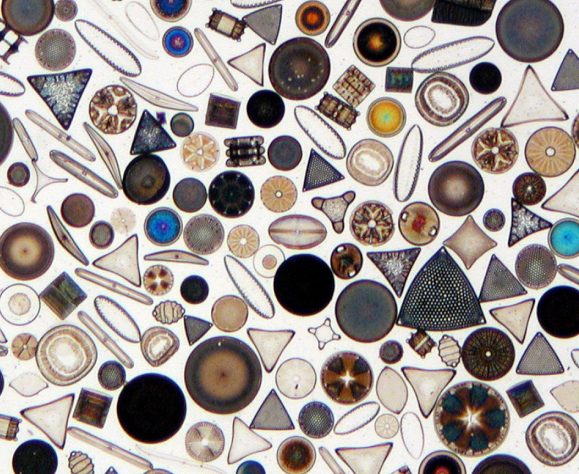
An arrangement of diatom shells. Wipeter, CC BY-SA 4.0 <https://creativecommons.org/licenses/by-sa/4.0>, via Wikimedia Commons.
Phytoplankton are tiny, microscopic plants found throughout our oceans. Like terrestrial plants and macroalgae, they produce oxygen as a byproduct of photosynthesis. This oxygen is released into seawater, then from the seawater into our planet’s atmosphere.
Role in the Food Web:
Phytoplankton make up the base of the marine food web. Like other plants, they are considered primary producers: organisms capable of producing organic compounds (the basis of life!) from inorganic compounds. This process requires energy from the sun, and is referred to as photosynthesis.
Photosynthesis produces carbohydrates and releases oxygen as a byproduct. The reaction requires carbon dioxide as an input. As a result, plants reduce atmospheric carbon levels as they conduct photosynthesis, converting carbon into stored energy.
Phytoplankton are primarily consumed by zooplankton, which are small, often-microscopic animals. These include copepods (think of Plankton from Spongebob) or larger crustaceans like krill. Larger organisms feed on zooplankton, which transports the energy produced by phytoplankton up the food web.
Other filter-feeding organisms like bivalves (clams, oysters, mussels, etc.) also consume phytoplankton.
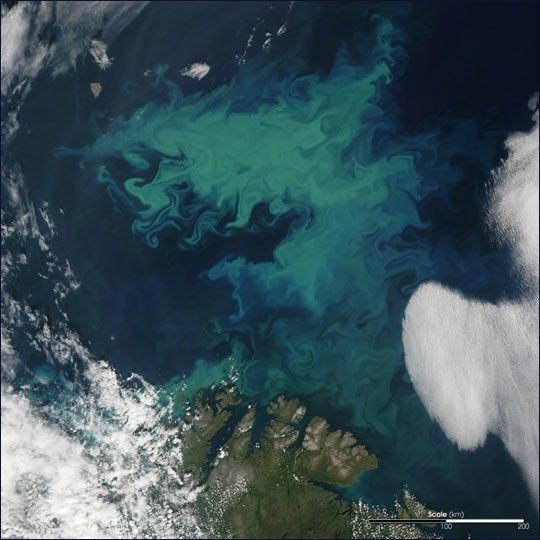
A large phytoplankton bloom off the coast of Norway, seen from space. NASA image courtesy of Jeff Schmaltz, MODIS Land Rapid Response Team at NASA GSFC
Distribution and Growth:
Phytoplankton are restricted to surface waters, as they require sunlight. They are distributed globally.
In lower latitudes, the primary limiting factor which regulates phytoplankton growth is nutrient availability. Phytoplankton require many nutrients to survive, grow, and photosynthesize, like phosphorous, nitrogen, calcium, iron, or silica.
These key nutrients can come from terrestrial sources, such as dust blown from deserts or runoff from rivers. The deep sea also provides nutrients to surface waters.
Light is unable to penetrate into the deep sea. Naturally, no photosynthesizing organisms live in waters below the euphotic zone, the zone where light can penetrate into seawater. All living organisms, even photosynthesizers, undergo respiration, which is essentially an opposite process to photosynthesis. The process of respiration requires oxygen consumption, and carbon and nutrients are released as byproducts. As a result, the deep sea is oxygen-limited, but nutrient-rich.
Processes like wind-driven mixing or upwelling currents can transport released nutrients into surface waters, making them available to phytoplankton. Regions of strong upwelling, such as the coast of California, are particularly productive regions. These areas support strong, rich ecosystems full of diversity.
In higher latitudes (polar regions), phytoplankton growth is also limited by light availability. Due to the presence of sea ice, surface waters receive limited light in the Arctic and Antarctic compared to waters in lower, ice-free latitudes. Phytoplankton growth periods are restricted to warmer months, which still may not be fully ice-free.

An illustration of the biological carbon pump. Phytoplankton fix carbon dioxide into organic carbon, which is moved up the food chain. A portion of this carbon sinks out of surface waters into deeper ecosystems. This carbon is taken up by deep sea organisms or buried into the seafloor. Samarpita Basu and Katherine R. M. Mackey, CC BY-SA 4.0 <https://creativecommons.org/licenses/by-sa/4.0>, via Wikimedia Commons.
Role in Climate:
Phytoplankton convert large amounts of carbon into a form usable to biological life forms. This carbon can be transferred up the food web, or can sink into the deep sea when organisms defecate or die.
The shower of sinking organic detritus is referred to as marine snow. This exported material feeds deep sea ecosystems. It also plays a role in regulating the carbon cycle. This process is referred to as the “biological carbon pump“.
Globally, the biological carbon pump is responsible for transferring approximately 10 gigatons (or 10,000,000,000 tons) of carbon from the atmosphere to the deep ocean annually. This carbon can remain isolated in the deep ocean for hundreds or thousands of years. However, anthropogenic (human-caused) activities impact the effectiveness of this pump. Productivity levels (phytoplankton growth rates) are altered by climate-related factors, such as increased ocean temperatures, acidity, and stratification. Additionally, overfishing or habitat destruction/alteration can also reduce the amount of organic carbon sinking into the deep sea.
Outlook:
Climate change is strongly affecting our planet’s oceans. Warming temperatures cause thermal expansion, glacial melting, and reductions in annual sea ice extents. The absorption of increasing amounts of carbon dioxide results in ocean acidification. This has detrimental impacts to living organisms, especially calcifying organisms like shellfish and corals.
The net global impact of climate change on phytoplankton is not fully understood. In polar regions, scientists predict that community composition will shift away from larger diatoms and towards smaller haptophytes and cryptophytes. This trend is concerning, as krill selectively feed on diatoms and are not able to feed as efficiently on small flagellates. This would result in a reduction in krill populations.
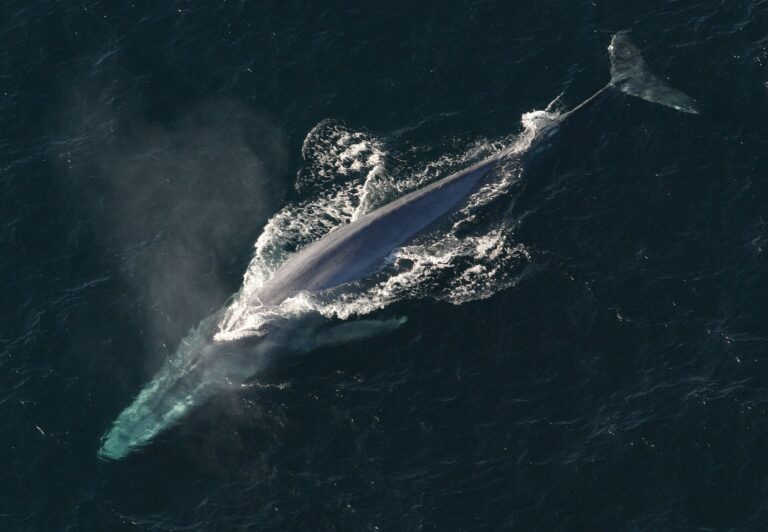
Krill are an important organism in the Antarctic food web. They are highly abundant and serve as a primary food source for baleen whales, seals, penguins, avian seabirds, fish, and squid. Shifts away from a diatom-dominated phytoplankton assemblage and towards one dominated by small flagellates will have cascading effects up the food web.
These changes would likely also impact the biological carbon pump. Diatoms have heavy, silica shells (pictured in the first image), which allow them to sink rapidly. This promotes the flux of carbon to the deep ocean. In addition, krill fecal pellets are dense and sink quickly, which also exports carbon to the deep sea. Organisms in deep ocean ecosystems that rely on this flux may not receive adequate food supply, including habitat-builders like sponges and deep sea corals.
Phytoplankton growth rates in light-limited polar regions are expected to increase alongside the decline of sea ice. However, shifts in community composition may limit the degree of positive effects resulting from increased phytoplankton abundance in the Arctic and Antarctic. In subtropical, warmer regions, phytoplankton populations are expected to decline by 50 percent.
Ultimately, changes in phytoplankton composition or abundance will result in notable, cascading effects up the food web. Migrating whale species may have difficulties finding their traditional krill feasts in Antarctic waters. Sharks and tuna may not be able to locate plankton-feeding baitfish species in high enough abundance to sustain their populations.
How to Love a Tiny Plant?
The question is: how do we motivate people to care about a group of organisms that they will never see? On the issue of rainforest destruction, videos of terrified jaguars or orangutans spark pathos-driven conservation efforts. But when it comes to disappearing or shifting phytoplankton communities, it is difficult to motivate people to feel deeply for something that is completely intangible to them.
Throughout this post, I have attempted to use two of my favorite strategies to motivate passion and care: appealing to an organism’s direct usefulness to humans and invoking charismatic megafauna. I referenced the percentage of oxygen in our atmosphere that phytoplankton produce. Then, I discussed the impact that shifts and reductions in their populations will have on seals, whales, and penguins. But, teaching a topic like this from the ground up is not concise. It is not easy to neatly package it into a quick blurb that will not just grab attention, but also effectively communicate the importance of this issue.
To pull back the curtain a bit, I created this blog because I want to be able to communicate science accurately and effectively to general audiences. I want to share current research, talk about some of my favorite organisms that I’ve painted, and motivate people to care and take action.
So, this Easter, I sit in front of my computer trying to figure out how to make the world care about the tiny plants that might just be the most important organisms on our planet. Hopefully someday, I will figure it out!
Pin this post to read later!

Diatom species Thalassiora rotula imaged under a microscope (the large ovals with fluorescing blobs inside of them), surrounded by bacteria (the “sprinkles”). This image was captured by my labmate and I during one of the courses I participated in as part of my master’s degree. We sought to examine whether the presence of vitamin B12-producing bacteria had any impact on phytoplankton fluorescence compared to non-vitamin B12-producing bacteria. Against our hypothesis, the diatoms housed with the B12-producing bacterial strain performed extremely poorly compared to our other groups. Very fun course, and my first time working in a Biosafety Level 2 laboratory! Image captured by me, ©LivInSeas, 2023