Ding dong!
Who’s there?
A fish…?
A small perch in a lake. Dellex, CC BY-SA 4.0 <https://creativecommons.org/licenses/by-sa/4.0>, via Wikimedia Commons.
In the middle of Utrecht, the fourth-largest city in the Netherlands, lies a manually-operated lock named the ‘Weerdsluis’. Locks restrict the flow of water through canals, raising and lowering the water level to allow the passage of ships.
However, blocking waterways can also block the passage of migratory fish. In the Netherlands, the fish swim through the city of Utrecht to reach their ancestral spawning grounds in the Kromme Rijn. But to reach this river, they must navigate waterways altered by human settlements.
The Weerdsluis sits in the middle of Utrecht’s Oudegracht, or “old canal”. When the lock gates are closed, fish are forced to wait until the gates open again before they can make their way upstream. But, how can the lock keeper know that there’s a queue of fish in front of the lock reminiscent of an Amsterdam nightclub on a Friday night?
The answer is surprisingly simple: Install a fish doorbell! (In Dutch: Visdeurbel)
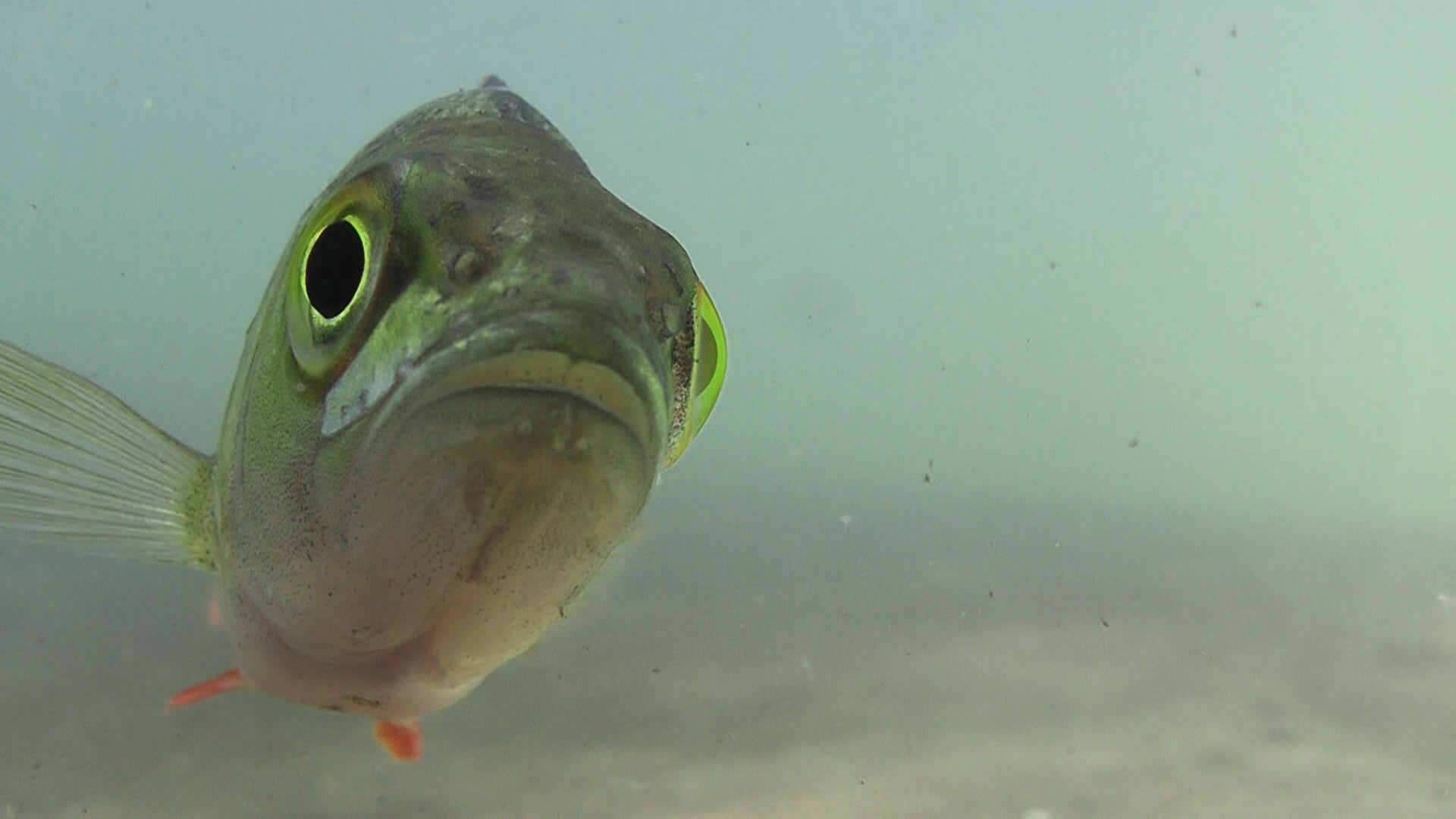
Perch photographed during an underwater dive in Germany. Andreas Steinhoff, Attribution, via Wikimedia Commons.
The municipality of Utrecht, the local water authority (Hoogheemraadschap De Stichtse Rijnlanden), and ecologist Mark van Heukelum (Dutch Wallfish) collaborated on the Visdeurbel initiative.
An underwater camera was installed at the lock, which connects to an online live stream. When viewers spot a fish, they can press a doorbell icon on the website. This sends an alert to the lock keeper, who checks to see how many fish have queued. Then, the lock keeper decides if the lock needs to be opened to send the fish on their way upstream.
The fish migration takes place between March and May annually. In 2025, thirteen different fish species were spotted passing the camera. And in 2024, the Fish Doorbell attracted 2.7 million viewers from across the globe!
The best hours for seeing fish are during the morning and evening in the local time zone (CET/CEST). But, it’s still possible to see cool fish on the feed outside of these hours.
Eels and pikeperch (or zander) are mostly spotted during the European night, making them a rare but extremely cool sighting on the livestream. Depending on your timezone, you might have a good opportunity to see these elusive fish!
A cluster of European eels. Dmitriy Konstantinov, CC BY-SA 3.0 <https://creativecommons.org/licenses/by-sa/3.0>, via Wikimedia Commons.
The European eel migrates 6000 kilometers from the Sargasso Sea in the middle of the Atlantic Ocean to European rivers and estuaries. Their life cycle is catadromous, migrating down rivers and into the sea to spawn.
European eels, like many other migratory fish, suffer from obstructions along their swimways, like dams and locks. In addition, their populations have also suffered from overfishing.
On average, migratory fish populations have plummeted by 76% globally since 1970. In Europe, that number is even higher, sitting at 93%. More than one million barriers restrict river flow in Europe.
Artificial barriers in rivers, like dams and locks, can prevent the movement of migratory fish to important sites they visit during distinct phases of their life cycles. Conservationists try to determine ways to protect and preserve the migratory swimways of fish. In California, efforts to restore salmon and steelhead populations led to the removal of four dams in the Klamath River watershed between 2023 and 2024. This effort restored 420 miles of habitat for these migratory fish species.
Not only does the Fish Doorbell raise awareness on this crucial conservation issue, but it also engages the public in a fun and productive way. Public engagement is vastly important, but it is still undervalued among the scientific community. It democratizes knowledge and improves scientific literacy among the general public. Engaging the public also improves trust in scientists and influences if and how people take action.
People rely heavily on digital media to learn more about science. This includes social media platforms, as well as websites, online blogs, and podcasts. The Fish Doorbell is an incredibly accessible, online method for the general public to both learn more about migrating fish and actively participate in facilitating that migration.
Pin this post to read later!