The One Resource You Need to Make Sustainable Seafood Choices
Over the years, I have fielded many questions from friends and family about how to make sustainable choices when buying seafood. These include, “how can I make sure my choices at restaurants are sustainable?” or “is farmed or wild-caught salmon better for the environment?”
In the early stages of my career, I worked in fisheries science. Unfortunately, my experience in fisheries science taught me is that there is no easy rule of thumb to answer these questions.
Determining the sustainability of a specific type of seafood depends on a number of factors. These include location, fishing gear used, relevant regulations and management practices where the seafood was sourced, impact on habitats and the environment, and general traceability of the industry.
Complex, right?
The good news is that there are plenty of scientists working in this field to aggregate this information and assess sustainability of fisheries and aquaculture endeavors. The even better news is that it is now easier than ever to find this information.
Thanks to these scientists, I have one simple method to share with you. It completely demystifies the topic of sustainable seafood and is extremely accurate, easily accessible, and regularly updated with scientifically-sound information.
Let me introduce you to one of the best resources online: Seafood Watch.
Seafood Watch is a program founded by the Monterey Bay Aquarium in 1999. It aims to provide science and management-backed recommendations for seafood choices. They assess the sustainability of both wild-caught fisheries and aquaculture operations. In addition to their digital platform, they have a series of quick, downloadable consumer guides by species, U.S. region, and sushi items.
Within this post, I will cover how to use Seafood Watch at the grocery store, what to do at a restaurant, and where some of the best places to buy seafood actually are. Then, I’ll transition into a deeper dive on what sustainability actually means in fishing and aquaculture.
Example: Grocery Store Salmon
Let’s say in this example that I want to buy salmon at the grocery store. Based on information on the packaging, I only know that it was Atlantic salmon farmed in Canada. I take out my phone, open Seafood Watch, type “salmon,” and select Canada as the location. The website then shows the following result:
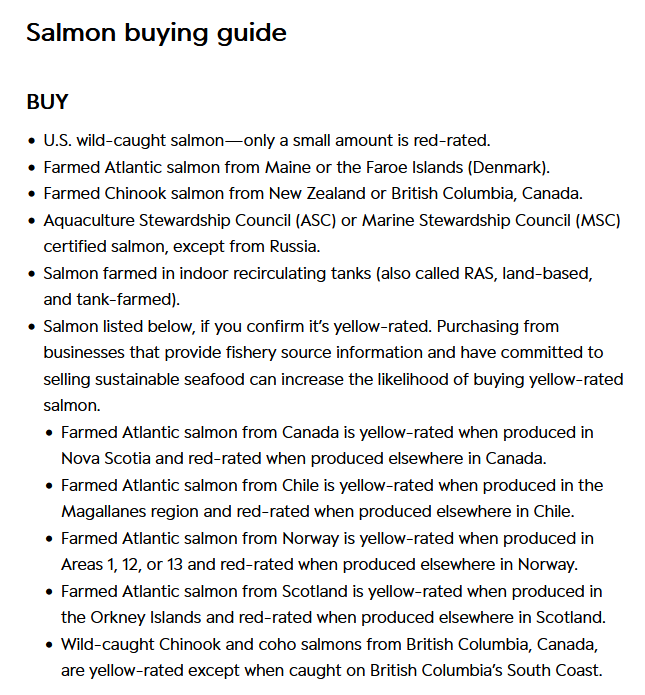
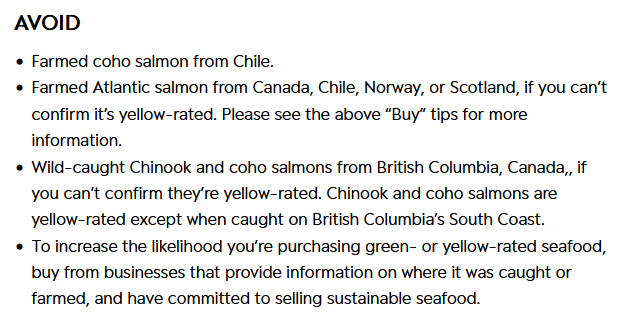
Glancing at this information, I see that it mentions that farmed Chinook salmon from British Columbia are recommended. But, farmed Atlantic salmon from Canada might not be the best choice.
Since the salmon I wanted to purchase is Atlantic salmon, I look closer at the packaging. It mentions the fish was farmed in Nova Scotia. When I scroll down on the site, I see the following options:
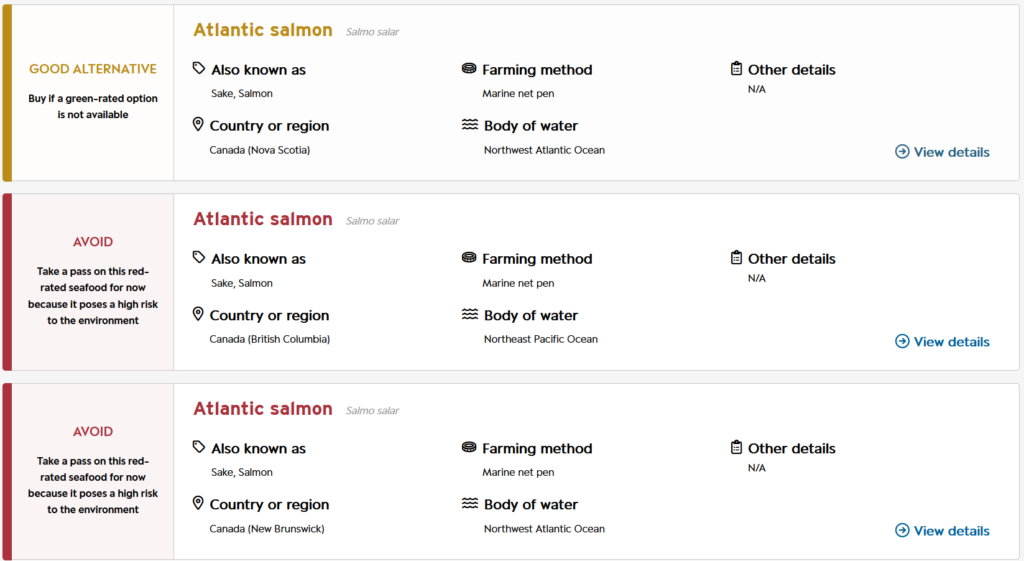
Great, Atlantic salmon farmed in Nova Scotia, Canada is considered a Yellow-Rated or “Good Alternative” species. Let’s pretend the only salmon in my imaginary store are Atlantic salmon farmed in Canada, so there are no green-rated options available.
And there you have it! Easy enough, right?
Seafood Watch has three categories: Best Choice (Green-Rated), Good Alternative (Yellow-Rated), and Avoid (Red-Rated). Each rating relates to the risk that procuring each species poses to the environment. Species may receive a red rating due to factors like management practices, bycatch likelihood, impacts on the external ecosystem, or if the population is particularly vulnerable to fishing exploitation.
An additional category, Certified Seafood, includes seafood certified by independent organizations to meet specific standards that align with sustainability goals. One of these organizations is the Marine Stewardship Council. The MSC is a non-profit aimed at recognizing and rewarding sustainable fisheries practices through their certification program.
Example: Canned Tuna
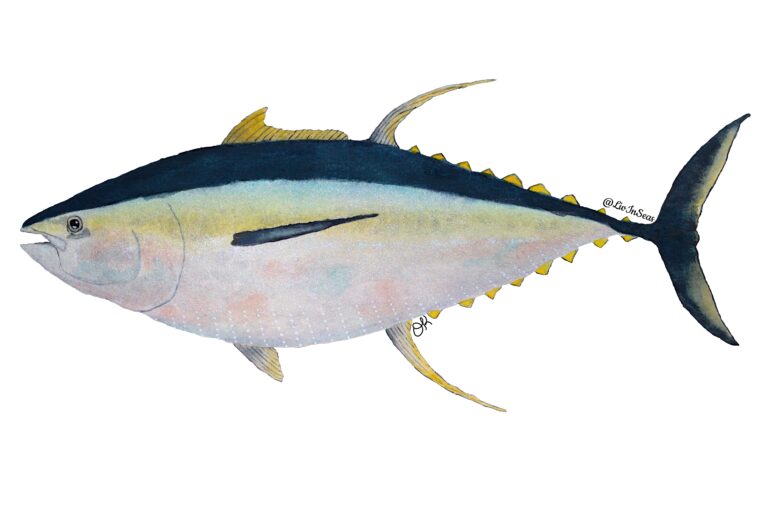
As a child growing up in the 2000’s, I always secretly feared that I was eating dolphin chunks along with my canned tuna. While that probably wasn’t a reasonable concern, tuna fisheries are still a hot topic when it comes to bycatch prevention and environmental protection.
Seafood Watch has an extensive guide on choosing sustainable canned tuna. “Dolphin safe” on its own does not guarantee sustainability. But, many environmentally-friendly brands will include terms indicating the tuna were caught with fishing gear that results in little bycatch, or incidental catch of other species not targeted by the fishery. These terms include “pole and line-caught,” “pole-caught”, “troll-caught”, “FAD-free”, “free school,” or “school-caught”.
They also list several brands in the United States that offer Best Choice (Green-Rated), Good Alternative (Yellow-Rabel), or Certified Seafood canned tuna. These include American Tuna, Fishing Vessel St. Jude, Ocean Naturals, Safe Catch, Wild Planet, and Whole Foods 365.
If there isn’t readily available information about the fishing method on the packaging, it’s a potential indicator that the tuna was not caught sustainably.
Making Sustainable Choices at a Restaurant:
Seafood Watch recently launched a restaurant partner program. They feature partner restaurants who commit to include at least one Best Choice (Green-Rated) seafood item on the menu. You can find nearby member restaurants on the interactive map located on the Seafood Watch website.
But what if you want to eat at one of the many restaurants that is not in the restaurant partner program?
The solution is easy: Just ask questions!
As I demonstrated above, all we needed to determine if supermarket salmon is sustainable was a species, location, and fishing/farming method. Restaurants generally know the basics regarding where their food is sourced from. Even knowing just the species and location could be enough to make informed choices.
Where Else Can I Buy Seafood?
Depending on your location, local seafood markets may be a good, sustainable choice. In the United States and Canada, local seafood markets can be found at localcatch.org.
Local seafood markets are also a good way to support your community and buy fresh, in-season seafood! Consuming locally-sourced seafood can reduce your carbon footprint by lessening or entirely negating emissions associated with packaging, processing, and transport.
Check out what exactly scientists look for when evaluating sustainability in Part 2: What Makes Seafood Sustainable?
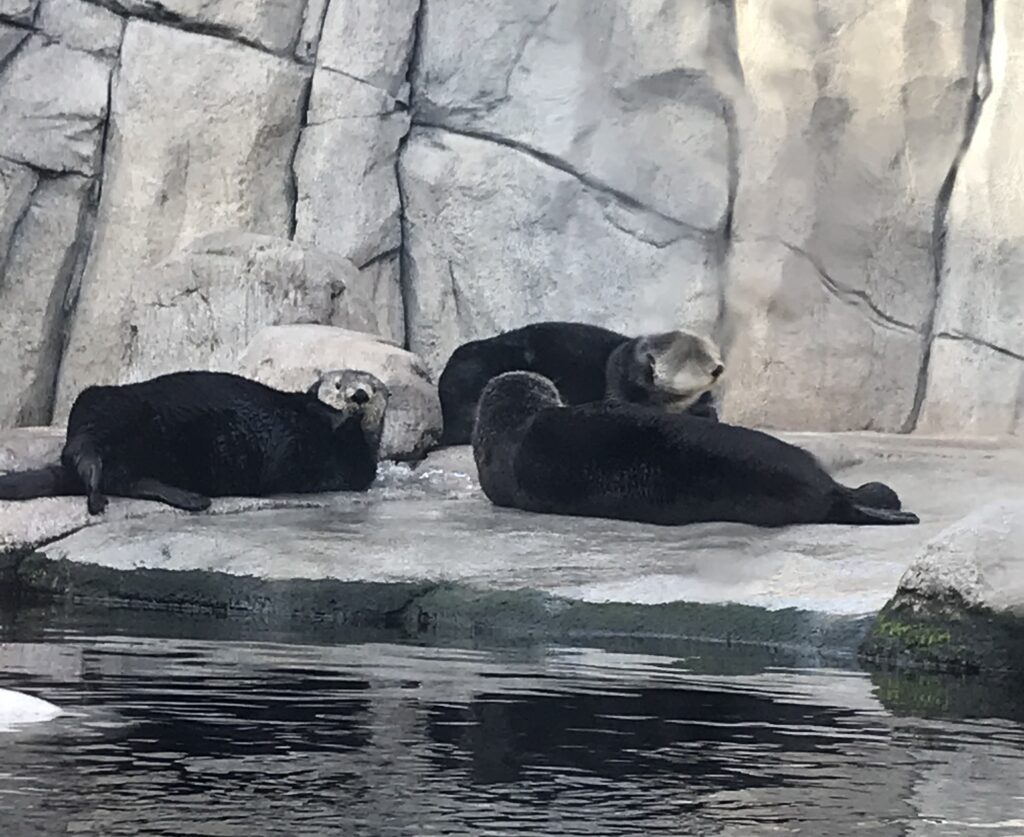
If you made it this far, here’s a photo of three of the Monterey Bay Aquarium’s sea otters hauled out on the rocky ground of their exhibit that I took when I visited in 2019! Visits to the MBA is what sparked my passion for marine biology as a child.