In the distance, illuminated by the soft light trickling through the ocean’s productive surface layer, swims a large, churning mass. As the mass moves closer, its true identity becomes apparent: a massive school of yellowfin tuna (Thunnus albacares). As they pass by, you notice some are the length of an adult man, if not larger. Their rounded, torpedo-shaped bodies and thin, crescent-shaped tails allow them to slice effortlessly through the water. They swim perpetually, without pause, from birth until death.
Where are they going? Perhaps they’re seeking a nearby feeding spot, using their keen sense of smell to locate potential prey. Or maybe, they’re on a longer journey, swimming across an entire ocean.
What is regional endothermy? Why do tuna undergo ‘bounce dives’? Why do they have a unique, special partnership with dolphins? Let’s dive in and learn about one of the fastest fish in the ocean.
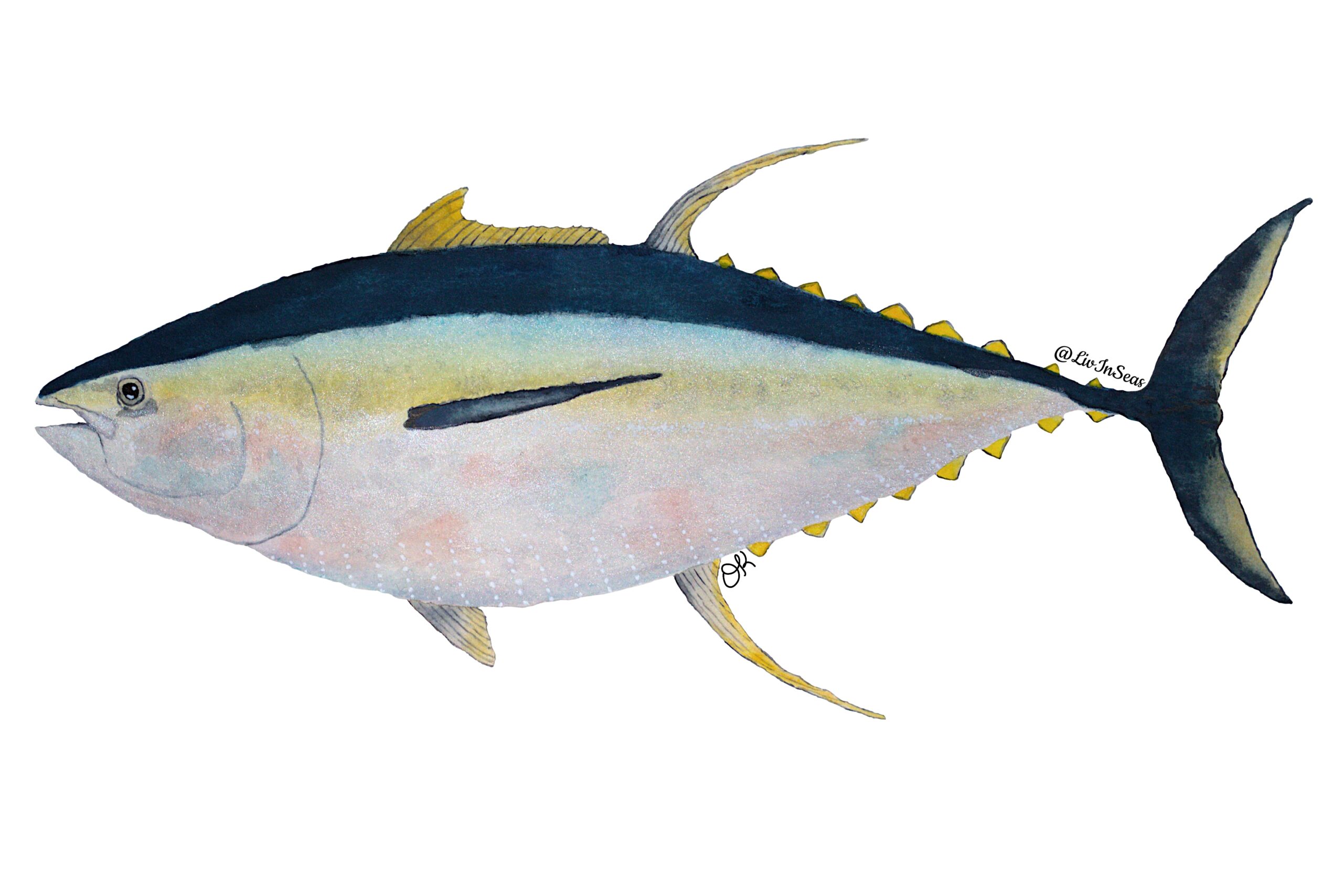
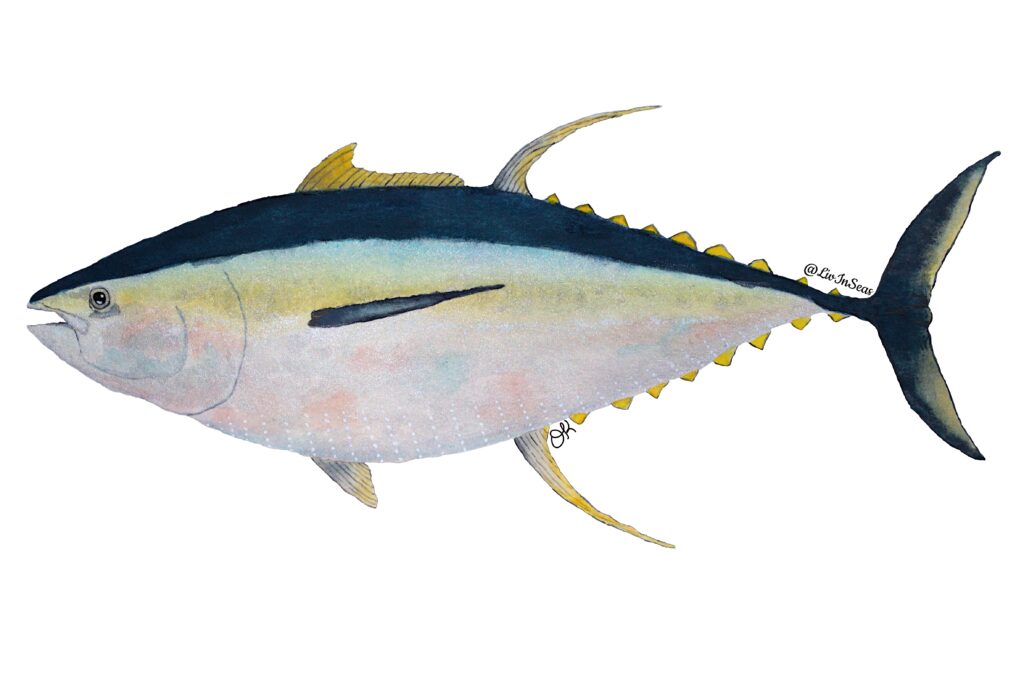
Water color painting of a yellowfin tuna (T. albacares) by me. ©LivInSeas, 2026
Yellowfin tuna have long pectoral fins, which extend beyond the origin of the second dorsal fin. Some yellowfin tuna have elongated, bright yellow second dorsal and anal fins. However, this variation is not observed in all yellowfin tuna. In the Pacific, the lengths of the second dorsal and anal fins seem to increase from east to west.
Yellowfin tuna live in tropical and subtropical regions across the entire planet. In the Pacific, they primarily range between 20°N to 20°S, but in summer months have been caught as far as 45–50° in both hemispheres. Yellowfin tuna are most abundant in the western and central Pacific Ocean. The populations in this region are estimated to make up roughly 46% of the global population.
Yellowfin are largely pelagic, meaning they live in the water column away from the seafloor or land. They occur in regions where sea surface temperatures range between 18 to 31 degrees Celsius (64 – 88 degrees Fahrenheit).
Vintage stamps featuring yellowfin tuna from various countries. Left: a 1980 stamp from Seychelles. Post of Seychelles – Zil Eloigne Sesel, Public domain, via Wikimedia Commons. Right: a 1970 stamp from Peru. Post of Peru, Public domain, via Wikimedia Commons.
Generally, yellowfin tuna spend most of their time in surface waters above the thermocline, a layer of rapid transition between the warm surface waters and the deep ocean below. However, the tuna will often dive into deeper waters.
Yellowfin tuna typically undergo ‘bounce dives’ to 150 to 250 meters (492 – 820 ft). Occasionally, they dive extremely deep. These deep dives reach an average depth of 1068 meters (3504 ft), with a mean duration of 45.5 minutes. The deepest recorded dive by a yellowfin tuna was 1602 meters (5256 ft).
Yellowfin tuna’s ability to undergo deep vertical dives is restricted by several factors. These include the capacity for heat retention, thermal inertia, cardiac function, and an individual’s specific tolerance for thermal stress.
Bounce dives are likely required to re-supply tissues with oxygen. Oxygen levels are generally limited below the thermocline, as phytoplankton are absent below the surface mixed layer. As a result, there is no direct oxygen source to these waters.
Tuna must constantly swim to move oxygenated water over their gills. While tuna may enter a restful state while swimming, they do not sleep like humans do. They don’t even have eyelids!
Fish within the genus Thunnus, the tuna, are regional endotherms. Regional endothermy refers to the ability to heat certain parts of the body.
Tuna are able to absorb heat from warm surface waters and reduce heat exchange in cooler waters through altering their blood flow and heart rates. They also generate heat in their muscles while swimming. This allows tuna to dive to deeper waters and enhance their feeding opportunities while maintaining relatively stable body temperatures.
Check out my post about the only known whole-body endothermic fish here!
A yellowfin tuna swimming, with elongated second dorsal and anal fins. Almcglashan, CC BY-SA 4.0 <https://creativecommons.org/licenses/by-sa/4.0>, via Wikimedia Commons.
Tuna are negatively buoyant, but their fins act as lift-generating surfaces. Atlantic bluefin tuna improve the efficiency of their movement by gliding. They utilize their negative buoyancy and lift-generating fins to descend at very shallow angles, allowing them to move horizontally rather than sinking.
During these glide periods, they beat their tail intermittently. In spite of the limited locomotive activity during these gliding periods, the bluefin tuna were still able to cruise at at a relatively quick rate of roughly 1.5 meters per second.
However, tuna also swim at extremely fast speeds. Yellowfin tuna are one of the fastest fish in the sea, reaching burst speeds of 48 kilometers per hour (~30 mph). Tuna can depress their fins into grooves, creating a flat, smooth surface to minimize drag. They also raise and adjust their fins during searching and feeding behavior, which enhances their maneuverability (yaw motion).
Globally across all four designated regions (east Pacific Ocean, west/central Pacific Ocean, Atlantic Ocean, and Indian Ocean), yellowfin tuna stocks are not overfished. However, catches in both the Atlantic Ocean and the west/central Pacific Ocean stocks have been slightly above maximum sustainable yield (MSY) in recent years. Continuations of these trends may result in overfishing.
Yellowfin tuna are primarily caught using purse seines, longlines, pole-and-line gear, and gillnets. Purse seining is the primary method used in all four regions to catch yellowfin. The use of fish aggregating devices (FADs) in purse seining is controversial, as it can increase bycatch rates.
In the United States West Coast Fishery, large purse seine vessels which target tuna in the eastern Pacific Ocean have 100% observer coverage. This means that every vessel in this fishery has a professionally-trained biological technician employed by the National Oceanographic and Atmospheric Administration on board gathering data and supporting regulatory compliance.
Tuna are highly migratory species. As such, effective management of their populations must take place on an international scale. Several regulatory commissions exist across oceanic basins for this purpose, such as the Inter-American Tropical Tuna Commission or the International Commission for the conservation of Atlantic Tunas.
Check out my guide to buying sustainable seafood, including canned tuna, here!
A school of yellowfin tuna. Marc Taquet, CC BY 4.0 <https://creativecommons.org/licenses/by/4.0>, via Wikimedia Commons.
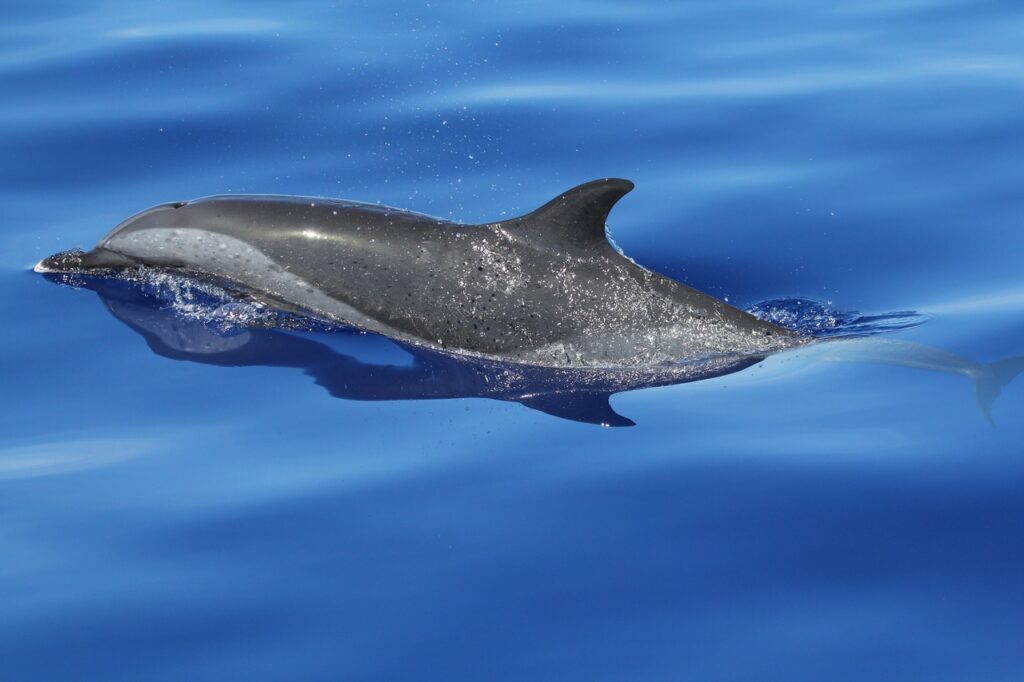
In the eastern tropical Pacific (ETP), yellowfin tuna reliably associate with pantropical spotted dolphins (Stenella attenuata). Large groups of dolphins and tunas will coalesce in the early morning, and often maintain this association throughout the day.
As discussed in a paper by Scott et al., 2012, researchers have proposed two hypotheses about how this association may benefit these species:
While both species may improve their foraging chances by combining their strengths (i.e. tuna’s stronger sense of smell and dolphin’s echolocation abilities), the feeding hypothesis is not as strongly supported as the predator hypothesis.
Prey resources between the two species are divided by several factors: time of day when hunting occurs, prey species, and size. However, feeding times between yellowfin tuna and spotted dolphins overlap in dawn hours. During these early morning hunts, a combined feeding frenzy might be the initial interaction between the two species which results in a day-long association.
Spotted dolphins and yellowfin tuna are similar sizes and have the same potential predators. In large groups, an individual organism’s risk of predation is lessened.
The pantropical spotted dolphin (Stenella attenuata), a famed tuna associate in the eastern tropical Pacific. Marie Hill, NOAA Photo Library, CC BY 2.0 <https://creativecommons.org/licenses/by/2.0>, via Wikimedia Commons.
While similar tuna-dolphin associations have been observed in other oceans, they occur far less frequently than those in the ETP.
The ETP has unique oceanographic features which may drive this association. The thermocline in the ETP is very shallow, often less than 60 meters (197 feet) deep. Below the thermocline lies a thick oxygen-minimum zone. These factors limit the vertical distribution of tuna, as tuna are oxygen-sensitive.
Yellowfin tuna spend most of their time above the thermocline in the ETP, so their habitat is compressed compared to other oceanic regions.
Spotted dolphins breathe air, and tend to stay closer to the surface.
As a result, both species reside closer in vertical proximity in the ETP than in other regions.
However, this vertical habitat compression doesn’t just affect yellowfin tuna. Species that prey on both tuna and dolphins, like sharks, are also impacted. As a result, both of these species may experience more encounters with predatory species.
In line with the predator protection hypothesis, the known association between large groups of tuna and dolphins likely lessens predation risk on an individual level.
Pin this post to read later!







_(Ifremer_00568-68027_-_25199).jpg)
.jpg)
I love this site! Not only do I find it extremely interesting and informative, but your art work is amazing! I always look forward to your next topic!
Thank you very much! Here’s a preview: absurdly large octopus