Why is Whale Poop a Hot Climate Topic?
Whale feces has emerged as an oddly hot marine science headline in recent years. A simple Google search yields results titled, “Could Whale Poop Help Fight Climate Change?” and “Whale Feces Represents One of the Greatest Allies Against Climate Change.”
At a glance, these headlines seem rather sensationalized. Whales are considered “charismatic megafauna.” These pop stars of the animal kingdom are well-known species who capture the attention of the public, supporting broader-scale conservation projects. Combining the urgent interest in climate change with the silliness of feces and the popularity of whales catches attention.
But, how valid are these claims? And through what mechanisms could whale feces have an impact on climate?

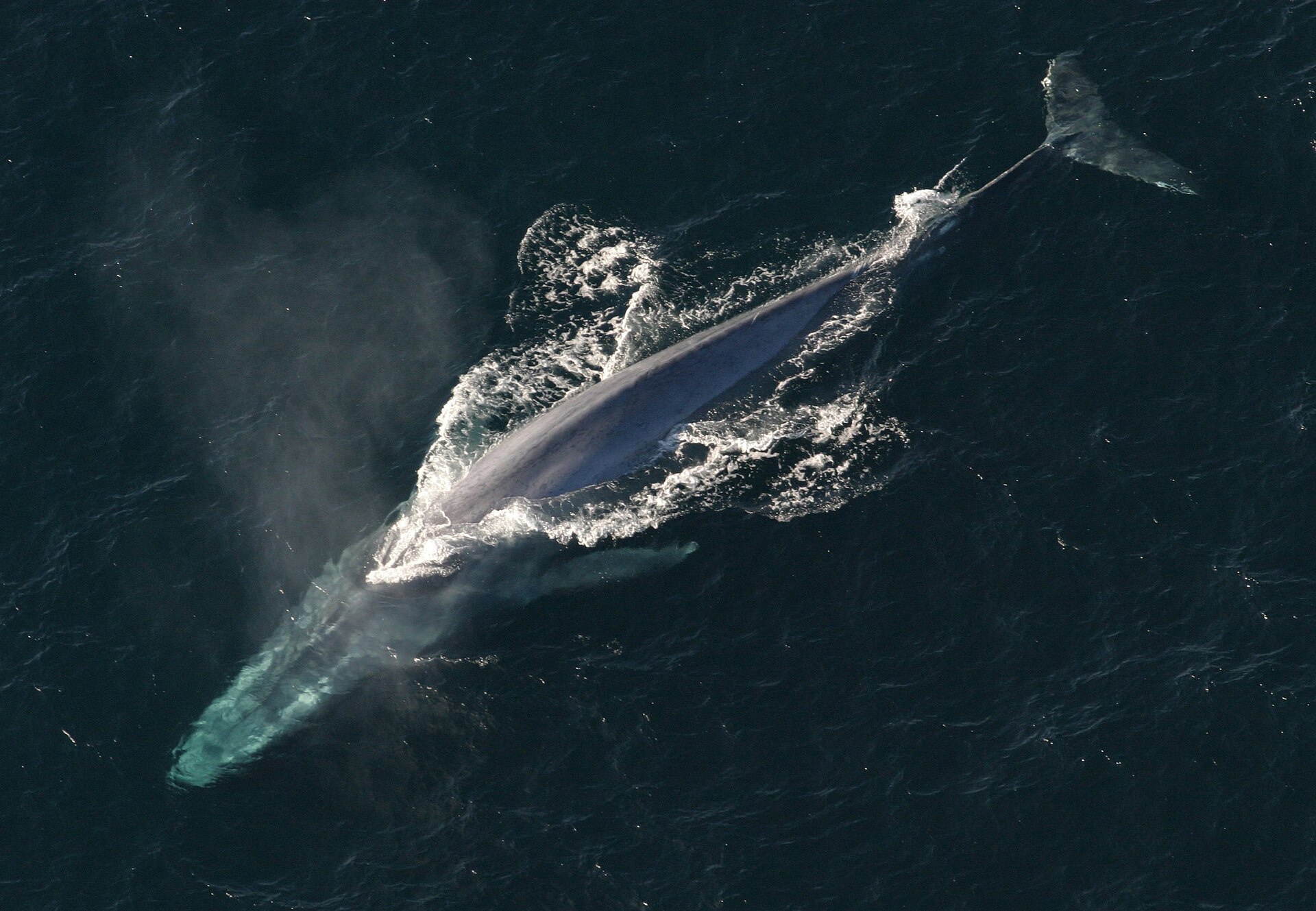
A blue whale, the largest animal to ever exist on Earth. And subsequently, Earth’s biggest pooper. NOAA Photo Library, Public domain, via Wikimedia Commons.
Background: Oceanic Nutrient Cycles
In order to understand why whale poop is important, we should first cover the basics of the oceanic carbon cycle.
Carbon is considered the fundamental building block of life. Carbon atoms flow through the environment, from air, moving between air, water, soil, bedrock. Oceanic, terrestrial, and atmospheric carbon reservoirs interact directly, facilitating exchange between these distinct spheres.
Surface waters exchange gases with the atmosphere based on diffusive gradients. As atmospheric carbon concentrations increase, greater amounts of carbon diffuse into the ocean.
Due to its molecular structure, animals cannot utilize atmospheric carbon directly. But, phytoplankton can process this inorganic carbon into organic carbon through photosynthetic processes. This organic carbon can be used for biomass and energy by living organisms. Photosynthesis occurs in surface waters and supplies the entire ocean with organic carbon.
So, to summarize: phytoplankton take up atmospheric carbon that diffuses into the ocean and converts it into a usable form for all organisms in the ocean. Whales, deep sea brittle stars, and even the canned tuna you ate last week rely on phytoplankton.
However, phytoplankton’s photosynthetic processes are limited by several factors. These include the availability of carbon, sunlight, and additional nutrients which support phytoplankton growth. Nirate, phosphate, silicate, calcium, and iron are examples of important macro- and micronutrients, and the required amounts of each vary by species of plankton.
Finally, this is where our whale poop factors into the picture!

An illustration of the oceanic whale pump showing how whales cycle nutrients through the water column. Roman J, McCarthy JJ, CC BY-SA 2.5 <https://creativecommons.org/licenses/by-sa/2.5>, via Wikimedia Commons.
The Oceanic Whale Pump:
Macronutrients that phytoplankton require, such as nitrate and phosphate, are limited in certain regions of the ocean. These are referred to as oligatrophic regions. Limited amounts of micronutrients, like iron, in surface waters can restrict phytoplankton growth. These regions include the Southern Ocean, and in the northern and equatorial Pacific.
Nutrient restrictions limit primary production rates and atmospheric carbon absorption into the ocean. However, these nutrients are abundant in different regions of the ocean, or at different depths.
Whales undergo extensive migrations. They spend their summers feeding in high-latitude regions and winter in more mild, tropical or subtropical regions. As they undergo these migrations, the whales carry large amounts of macronutrients with them from their summer feeding grounds across thousands of kilometers. They then release these nutrients into surface waters through excretion processes–urination and defecation.

A humpback whale breaches in the Hawaiian Islands Humpback Whale National Marine Sanctuary. J. Moore/National Oceanic and Atmospheric Administration, Public domain, via Wikimedia Commons.
Within their feeding grounds, whales also transfer nutrients from nutrient-rich deeper waters into more-depleted surface waters.
This is a particularly important source of iron into surface waters of the Southern Ocean, where iron is a key limiting nutrient on phytoplankton growth rates. The iron concentration of whale feces is ten million times greater than concentrations in Southern Ocean surface waters, and may also provide iron in a bioavailable form thanks to the whale’s digestive processes.
Will Whale Feces Save Us All?
Is whale poop the secret key to mitigating climate change? Well in short, no.
While whales substantially contribute to one process in the ocean that amplifies removal of carbon from the atmosphere, there are a few important points to keep in mind before getting carried away with the “pop science” of it all.
In general, whale species globally suffered catastrophic population declines due to widespread whaling efforts over hundreds of years. While we have seen degrees of recovery in some species, like the humpback whale, other species like the North Atlantic right whale are still struggling to bounce back.
Today, whales are still threatened by anthropogenic impacts. Shifts in marine ecosystem functioning which can be attributed to climate change have been recorded across the globe. High-latitude ecosystems, where whales feed during the summer, are more strongly impacted by climate change. These changes can make it harder for whales to find food.
Additionally, whales must compete with humans for space and resources. Ship strikes from vessel traffic, fisheries gear entanglements, underwater noise, pollution, and competition with fisheries for food sources all impact whale populations.
In the Southern Ocean, many whale species spend the summer gaining biomass by feeding on nutritiously-dense krill. However, krill are extensively fished in the Southern Ocean.
For the first time ever, krill fisheries in the Southern Ocean reached their annual quota in 2025, resulting in an early closure of the fishery. More fishing means less food available for whales. Political efforts to implement more Marine Protected Areas in the Southern Ocean have been repeatedly blocked for years by Russia and China, who cite concerns about the impacts on their commercial exploitation of krill and fish stocks.
The Real Solution?
If a major factor impacting whale population health is climate change, then why do so many “pop science” headlines imply that whales will significantly mitigate climate change?
In the article, “Do whales really increase the oceanic removal of atmospheric carbon,” by Jan-Olaf Meynecke and colleagues, Olaf-Meynecke poignantly points out that articles titled, “Restoring whales to their pre-hunted numbers could capture 1.7 billion tons of CO2 a year” and “Whales can have an important but overlooked role in tackling the climate crisis, researchers say,” excessively simplify complex relationships to gain attention from general audiences.
These “pop science” tactics often gather lots of attention and views on social media, but often minimize legitimate causes and solutions, if not present blatantly incorrect or misinterpreted information.
Olaf-Meynecke writes, “The implications of a believe-driven process can result in a diversion of attention towards well-established methods of carbon sequestration. It can result in attention and resources drawn away from proven, effective, nature-based solutions to climate change.”
While whales contribute to boosting carbon sequestration in the ocean, it’s well past time for us to take a look in the mirror, and realize that the only ones who will save us are ourselves.

A mother and baby sperm whale swim off the coast of Mauritius. Gabriel Barathieu, CC BY-SA 2.0 <https://creativecommons.org/licenses/by-sa/2.0>, via Wikimedia Commons