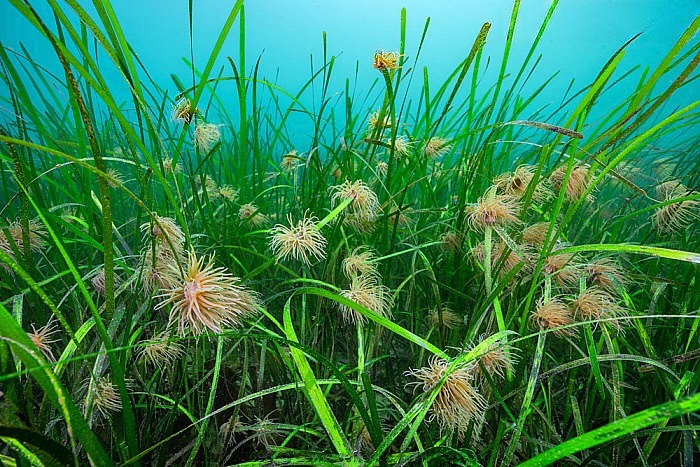
Seagrasses: Why You Should Care About the Ocean’s Rapidly-Vanishing Lawn
The most famous ecosystem of the United States’ West Coast is undoubtedly the kelp forest. The towering, swaying fronds are iconic, providing habitat for swaths of marine life.
However, another green ecosystem rests in the shallows, often overlooked. It provides foundational habitat for the life cycles of many species, protects seaside communities, and sequesters massive amounts of carbon annually. But, these ecosystems decline at a rate of 7% per year, stripping habitat for juvenile fish, releasing stored carbon, and stripping natural storm protections from coastal communities.
Meet seagrass, the ocean’s very expensive lawn.

A field of Zostera in bloom. Yes, those are flowers! Lewis Jefferies, CC BY 3.0 <https://creativecommons.org/licenses/by/3.0>, via Wikimedia Commons.
Seagrasses, including eelgrass and surfgrass (genus Phyllospadix) on the United States West Coast, are not algae. They are monocots, like other grasses, palm trees, wheat, or orchids. Seagrasses have roots, stems, leaves, flowers, and seeds.
Seagrass meadows are found in very shallow waters. Zostera marina, the most common eelgrass species in the northeast Pacific, grows in continuous beds from 0.5 t0 10 meters (1.6 – 32.8 feet), and occurs in patches up to 13 meters (42 feet).
Seagrass is commonly found in bay and estuarine environments along the coast. Because of its close proximity to land, it provides a myriad of protective ecosystem benefits. These include reducing coastal erosion by reducing wave energy and stabilizing the seafloor with their root systems. However, this proximity threatens these ecosystems. Seagrass is vulnerable to direct damage through certain fishing methods, anchoring and other boating activities, and coastal development. Additionally, indirect sources such as terrestrial runoff also have significant impacts.
The Economics: What Does Seagrass Do For Us?
Total valuation of ecosystem services provided by seagrass has been tricky for researchers to quantify. This is in part due to the indirect nature of the provided services. Additionally, the global distribution of the plant requires highly-regional assessments of local economic drivers.
The 2016 paper, A review of seagrass economic valuations: Gaps and progress in valuation approaches, by Bryan Dewsbury and colleagues presented the Seagrass Ecosystems Valuation (SEV) Model to quantify ecological functions and their corresponding economic contributions.
The model highlighted tourism revenue, commercial fish market value, economic effects of carbon dioxide reduction, and coastal property value as the primary economic outputs of seagrass ecosystems. (See section titled ‘Ecological Functions’ below for further information on the drivers of economic outputs.)
Researchers estimated that the value of the total ecosystem services provided by Caribbean seagrass alone sits at roughly $255 billion per year. In the 2023 paper, The natural capital of seagrass beds in the Caribbean: evaluating their ecosystem services and blue carbon potential by lead author Bridget Shayka, the University of Michigan-led team determined values for the various economic outputs from seagrass ecosystems. This total value includes $88.3 billion per year in carbon storage.
Seagrasses are globally-distributed. So, if seagrass exclusively growing in the Caribbean generates $255 billion per year in value, one can only imagine the global total!

Eelgrass (Zostera marina) meadows captured from Lilia Beach in Plouguerneau, France. The image was captured half-above and half-below the surface of the water. Olivier Dugornay (Ifremer), CC BY 4.0 <https://creativecommons.org/licenses/by/4.0>, via Wikimedia Commons.
Ecological Functions:
Supports Fish and Marine Species:
Seagrass ecosystems play a crucial role in the life cycles of many marine species, including fisheries-relevant species. Herring rely on eelgrass beds in the northeast Pacific Ocean for spawning habitat, depositing their eggs on the leaves. Juvenile Chinook salmon are also supported by eelgrass habitats during their out-migrations into marine environments.
Seagrass and mangrove habitats serve a distinct purpose as “nurseries”. They provide crucial habitat and shelter for young fish and invertebrates, fostering their growth. These habitats are essential to the life cycles of these organisms. Many of these species are valuable to commercial or subsistence fisheries efforts.
The physical, three-dimensional environment also provides habitat for many epiphytic/epibiotic organisms. Epiphytes and epibionts are plant and animal species (respectively) which live on the surfaces other organisms. In seagrass communities, various algaes, crustaceans, polychaete worms, nudibranchs, sea anemones, sponges, and many more species all make their homes on seagrass blades.
Coastal Community Protection:
Many structural coastal ecosystems, such as kelp forests and coral reefs, provide valuable protection to seaside communities from storm surge, rising sea levels, and coastal erosion. Seagrass communities are no exception.
Eelgrass patches significantly reduce wave heights by altering local hydrodynamics. Specifically, as the moving seawater imposes drag forces on marine plants and seaweeds (and vice-versa), the water loses significant kinetic energy.
Seagrasses form extensive root systems in the sediment. These roots hold the sediment in place, which prevents erosion from storm surges.
Water Quality Remediation:
The mechanical impact of seagrass beds also impacts water quality. As seagrasses reduce local current speeds, turbidity is reduced. Turbidity refers to the cloudiness of a fluid, due to the presence of suspended particles. Increased turbidity reduces the amount of light which penetrates the water column, restricting the growth of photosynthetic organisms (like seagrass). However, when drag forces from the seagrass reduce water flow speeds, these suspended particles sink to the seafloor, a process referred to as sedimentation. As this process improves water clarity, more light reaches the seafloor. This subsequently boosts the growth rate of seagrass, acting as a positive feedback loop.
Additionally, seagrasses also alter the chemical composition of seawater. Not only do they absorb nutrient runoff from land, but they can also uptake nutrients from the sediment and release them into the water column in nutrient-poor areas.
During the day, seagrasses raise the pH and oxygen levels in the surrounding water column through photosynthetic processes. All organisms in the marine environment benefit from dissolved oxygen sources, like marine plants and algaes. But calcifying organisms in particular benefit from these modifications to pH regimes. Lower (more acidic) pH environments interfere with the chemical processes involved with calcification. As a result, calcifying organisms including corals, molluscs, and even certain phytoplankton are impacted by ocean acidification.
Carbon Sequestration:
Seagrasses store organic carbon directly in their biomass. In addition, they trap carbon within the sediment itself, which can remain there for decades or centuries. Seagrass meadows sequester a disproportionate amount of carbon relative to their actual biomass: while they cover less than one percent of the ocean’s surface, they contribute to roughly ten percent of the ocean’s annual carbon sequestration–also known as blue carbon. Seagrass is incredibly efficient at carbon capture compared to other ecosystems!

Three Pacific brant geese feeding on eelgrass in Bodega Bay, California. Eelgrass provides important stopover habitat for migrating birds. Nicole M. Kollars, Amy K. Henry, Matthew A. Whalen, Katharyn E. Boyer, Mathieu Cusson, Johan S. Eklöf, Clara M. Hereu, Pablo Jorgensen, Stephanie L. Kiriakopolos, Pamela L. Reynolds, Fiona Tomas, Mo S. Turner and Jennifer L. Ruesink Photo credit: Gabriel Ng., CC BY-SA 4.0 <https://creativecommons.org/licenses/by-sa/4.0>, via Wikimedia Commons.
Threats to Seagrass Ecosystems:
The most significant threats to seagrass ecosystems are directly due to larger systems at play. The major threats include reductions in water quality and clarity, often as a result of plankton blooms and suspended sediments. They are also physically harmed through coastal construction and development, as well as fishing and aquaculture practices which can damage the seafloor. Additional threats include pressure from invasive species and disease.
(Read more here: Marine Protected Areas Benefit You, Me, and the Sea)
Responsible Boating & Ocean Activities:
Fortunately, when visiting the ocean, there are many direct actions you can take to minimize damage to these important ecosystems! While boating activities contribute to the pressure these ecosystems face, there are easy modifications that environmentally-conscious boaters can make.
Anchoring, direct damage from propellers, turbulence from boat wakes, and mechanical damage from the hull (grounding) can all severely damage seagrass communities. Once disturbed or uprooted, seagrass is slow to recover. A study in Chesapeake Bay found that it took eelgrass beds 2.7 years on average to fully recover from the scar of one boat propeller. Naturally, in regions of high traffic, this impact is intensified.
One non-regulatory strategy which contributes to conservation plans is the establishment of “voluntary no-anchor zones.” Several regions in Washington State have implemented these, such as popular tourism destination Port Townsend. These zones appear on navigation apps, and request for environmentally-conscious boaters to anchor outside of set buoys to protect the eelgrass, as well as the popular local species which rely on it like crabs and salmon. Plus, eelgrass meadows aren’t the firmest substrate for anchoring, so it benefits boaters as well!
Due to the ecological importance of these ecosystems, many states and regions have made conserving seagrass a high priority. Washington State has developed a statewide Kelp Forest and Eelgrass Meadow Health and Conservation Plan, which aims to conserve at least 10,000 acres (~40.5 sq. km) of kelp forest and eelgrass meadow habitat by 2040.

Two broadnose pipefish sharing a moment. Look at how similar they look to seagrass! Pipefish are probably my favorite residents of the eelgrass meadows, they’re adorable. Miguel Mendez from Malahide, Ireland, CC BY 2.0 <https://creativecommons.org/licenses/by/2.0>, via Wikimedia Commons.
A Restoration Case Study: Morro Bay
An amazing eelgrass recovery story comes from the backyard of my bachelor’s degree alma mater, California Polytechnic State University, San Luis Obispo!
20 minutes north of SLO, on California’s famous Highway 1, sits Morro Bay. Morro Bay is an iconic little port city, framed by the towering Morro Rock, one of nine iconic volcanic “sisters” that loom over the area.
In 2007, eelgrass covered 344 acres of Morro Bay. By 2017, this number dwindled to 13 acres.
However, in 2023, the total eelgrass in the bay now totals 750 acres! So, how exactly did this ecosystem recover?
The not-so-simple answer: well, a lot of things! Ecological systems are complicated, many different factors can work together or against each other.
A 2024 blog post covers some of the influential factors which the Morro Bay National Estuary Program (MBNEP) believes contributed to this surge. One that I find particularly interesting is coastal erosion. While initial erosion increased depth and turbidity in the estuary, which is bad for eelgrass, over time the MBNEP believes this process could have eroded more shallow, suitable habitat for the eelgrass.
Additionally, the MBNEP worked with local colleges and universities to undergo extensive restoration efforts between 2017 to 2022, re-introducing eelgrass to regions where it had previously vanished from.
However, another big factor that the MBNEP attributes to the increase in population may be the Pacific Decadal Oscillation. Since 2020, a strong negative phase (La Niña) has kept sea temperatures cooler, which benefits eelgrass. However, they noted that this is not the only factor that contributed to the population rebound, as eelgrasses in the bay heavily declined during the previous La Niña phase.
What could this mean as we transition into a “super El Niño?”
Marine heatwaves can have negative impacts that directly harm eelgrass (i.e. harmful algal blooms, disease spread, changes in species compositions/mortality events).
However, Morro Bay’s thriving eelgrass population is healthy and thriving, increasing its resilience to climate events. The MBNEP believed that Morro Bay’s eelgrass was nearing carrying capacity, the maximum population size of a species that can be sustained in an environment, in 2023. Additionally, the bay’s eelgrass has concretely demonstrated that it can bounce back from seemingly catastrophic population declines. Since multiple environmental and human factors impact eelgrass health, it is impossible to fully predict the future. But the efforts of the MBNEP have ensured that the eelgrass, as well as all the organisms that rely on it, are in the best possible position.
The most important factor? Morro Bay’s eelgrass has a broad community of people who deeply care about the health of the ecosystem!