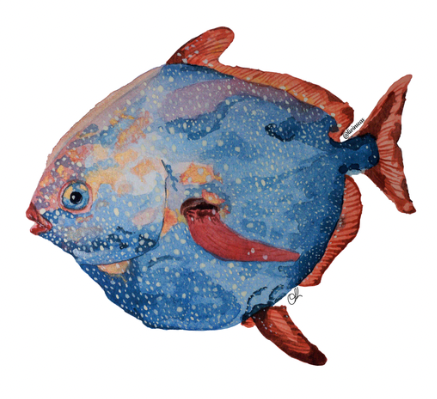
Species Spotlight: Louvar
The louvar (Luvarus imperialis) might be the ocean’s best-kept secret. The range of this rare, silver and gold-colored fish spans across the entire globe, although it is primarily found in the Indo-Pacific region. In spite of this, it is rarely seen.
The species is also known as “silver king” or “emperodor” (Spanish for “emperor”), and is sometimes referred to as the “Cadillac of fish”. Its species name, “imperialis“, means “of the empire/emperor,” which may refer to the palatability of its mild, sweet flesh. However, due to the frequency of parasites found in the fish, it may be removed from sale on the rare occasion that it is present in markets.
The louvar is an enigma of the open sea. It is the most beautiful fish you have never heard of. It’s a majestic mystery cloaked in glistening golds, shining silvers, and robust reds. With little known about the species, what can we uncover about the secretive louvar?
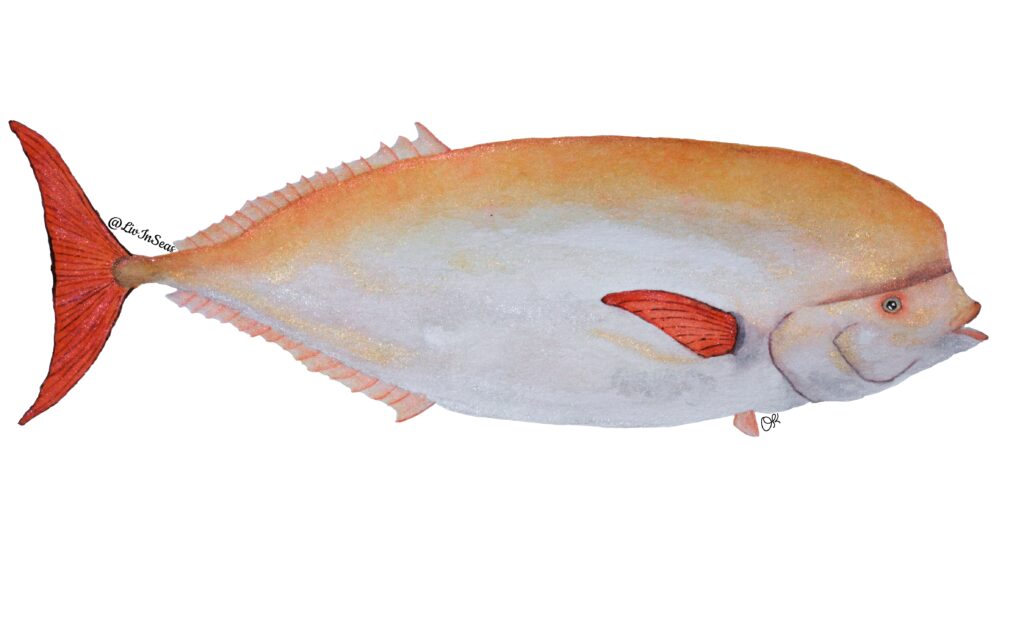
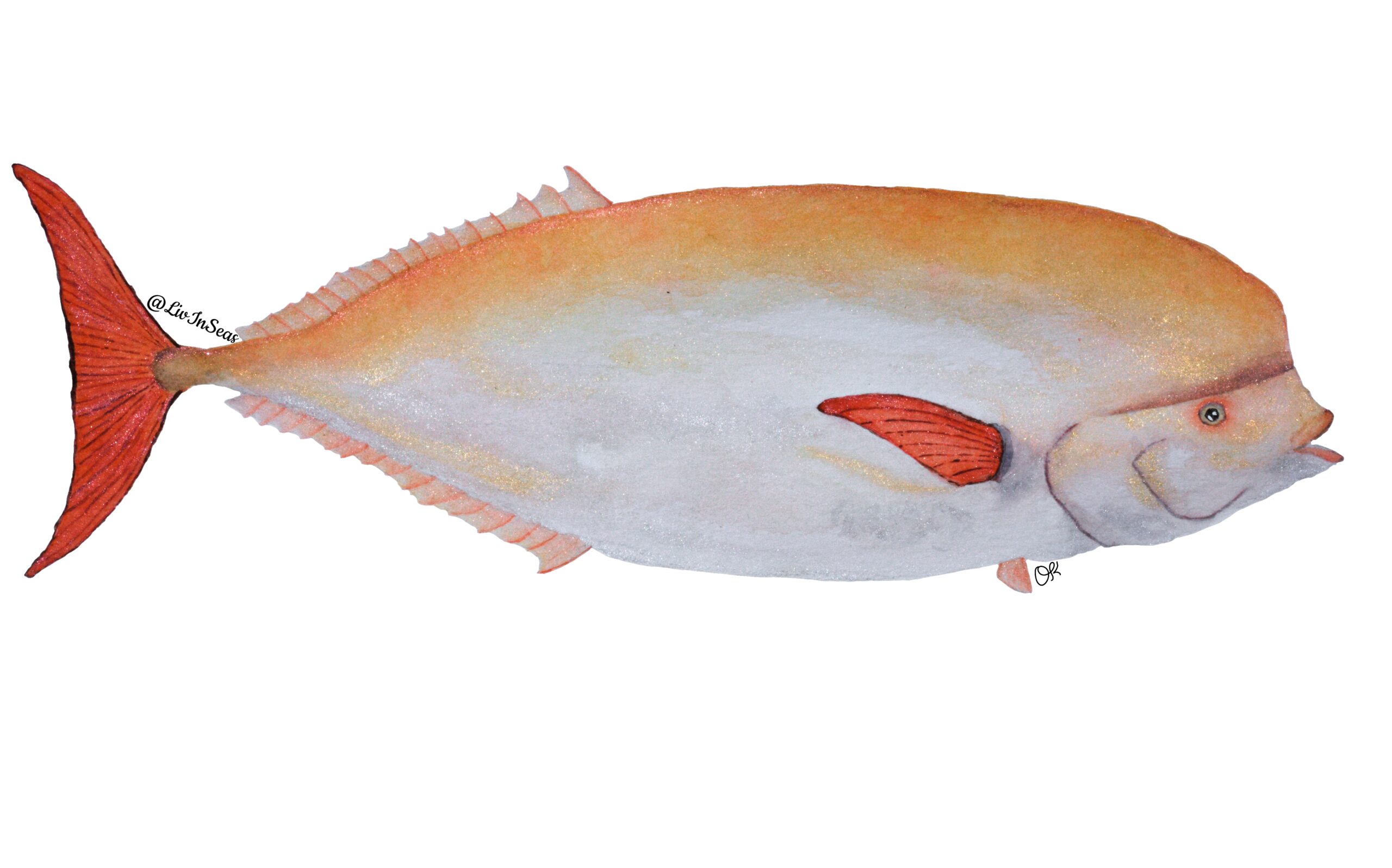
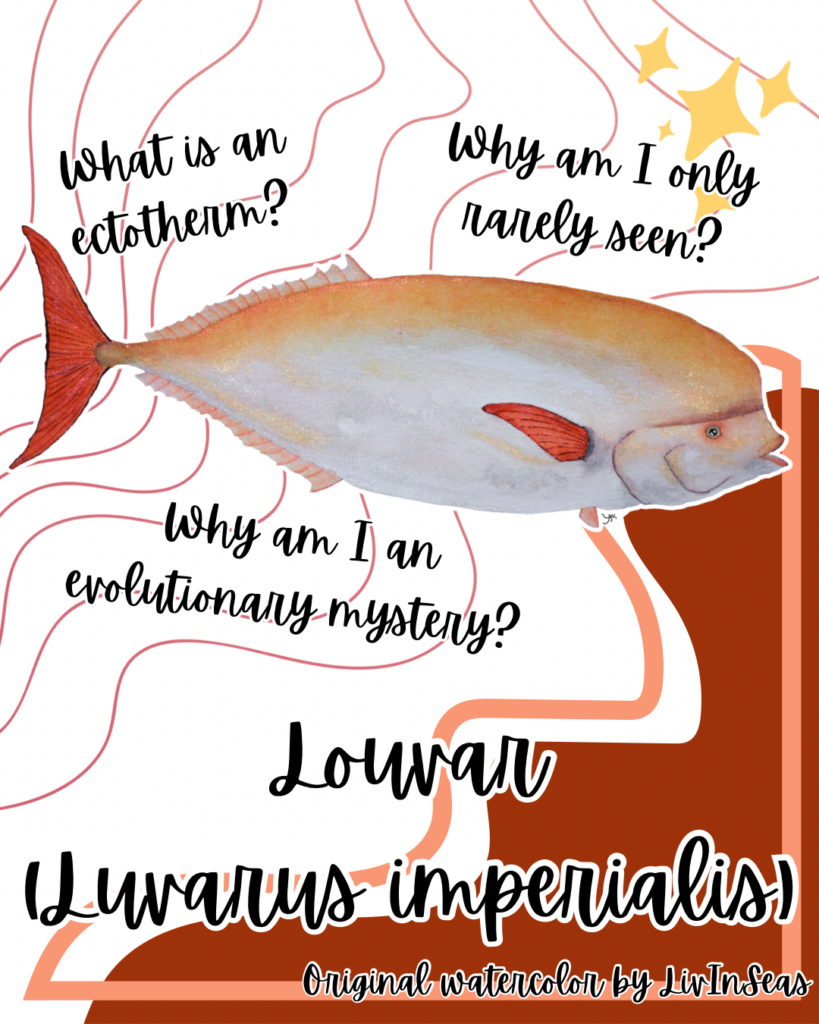
Water color painting of a louvar (L. imperialis) by me. ©LivInSeas, 2026
Appearance:
Louvar have elongated, oval-shaped bodies which taper towards the tail of the fish. Their forehead is large and bulging. Louvar have a small mouth and eyes, and their long-based anal and dorsal fins lack spines. The lack of spines in these fins contributes to streamlining the body while swimming. Louvar evolved highly-specialized features which suit life in the pelagic ocean. The species has experienced little structural change since the early Eocene or late Paleocene (~59.2 – 47.8 Mya).
Louvar are primarily silver in color, with some pink or orange tint. The fins are similarly pinkish-orange.
The maximum recorded length of a louvar is 200 centimeters (~79 inches). However a length of 152 centimeters (~60 inches) is more common. Louvar can weigh up to 150 kilograms (~331 pounds).
Juveniles are noticeably different in appearance, covered in black spots. The placements and lengths of the louvar’s fins are also different in their juvenile morph compared to their mature form. The body and head shape dramatically change between the juvenile and adult forms.
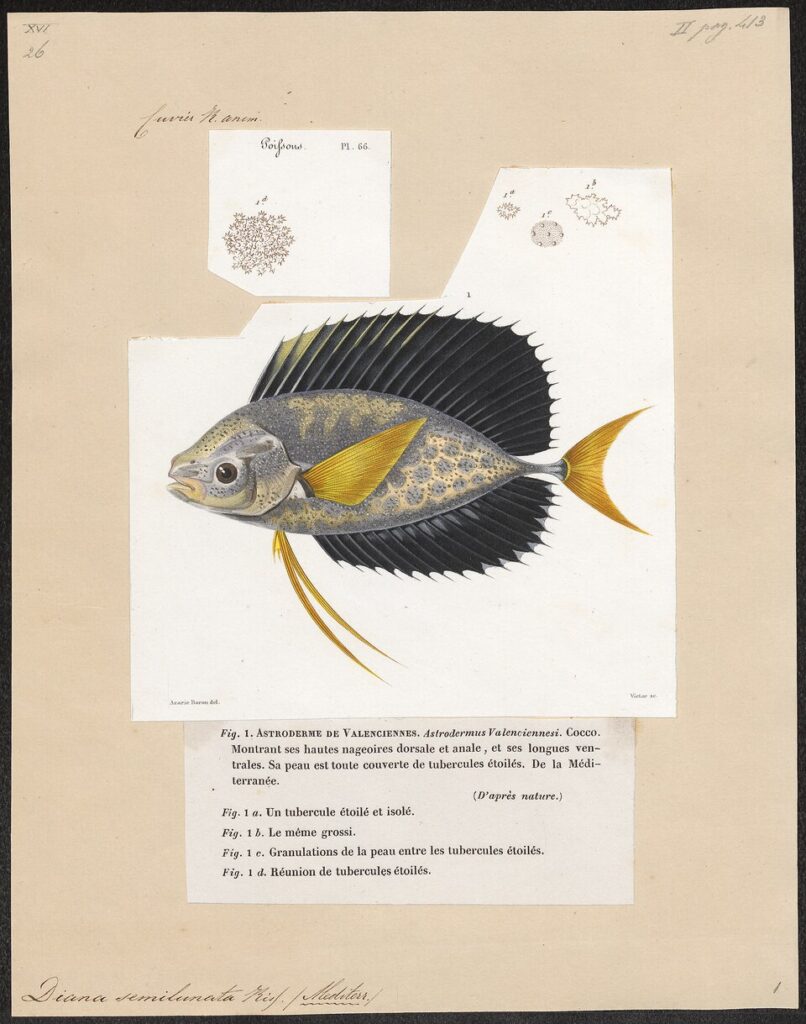
An illustration of the juvenile form of the louvar, by Georges Cuvier, 1828. Special Collections of the University of Amsterdam, Public domain, via Wikimedia Commons
Range & Habitat:
Louvar have a global distribution, although they are most commonly found in the Indo-Pacific. Their distribution in the Atlantic seems to be more localized. Louvar are also present in the Mediterranean, evidenced by scattered records.
The species is oceanic and found near the surface or in deep waters (maximum depth: 200 meters/~656 feet).
Biology:
Researchers in the early 20th century believed the louvar may be related to tuna and swordfish, due to its similar adaptations for life in the open ocean. However, based on genetic evidence, its closest relatives are small, reef-associated fish. Their relatives live vastly different lifestyles compared to the large, pelagic louvar.
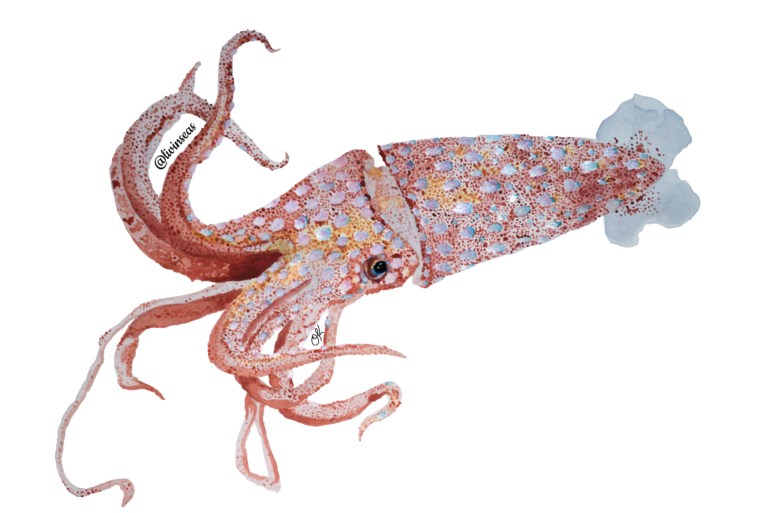
The louvar’s mouth is described as being, “small, weak, and toothless.” Adult louvar feed on gelatinous planktonic animals like jellyfish, salps, and ctenophores (comb jellies).
One large female louvar (173.5 centimeters/~68 inches) found stranded on the coast of Florida was carrying approximately 47.5 million eggs. The species is solitary in nature.
Endothermy?
Endothermy is not a common trait among fish, however it is present in several pelagic species. It refers to the ability of an organism to metabolically control its body temperature, otherwise known as being “warm blooded.”
As previously discussed, the closest relatives to the louvar are reef-associated fish from the order Acanthuriformes. These include surgeonfish, unicornfish, and tangs (like the famous blue tang, also known as Dory from Finding Nemo).
Examination of louvar specimens revealed some interesting findings, as detailed in the paper, “An enigmatic pelagic fish with internalized red muscle: A future regional endotherm or forever an ectotherm?” by Martin C. Arostegui and colleagues.
An Evolutionary Puzzle:
In this 2023 study, the research team noted that there was no evidence to support cranial or visceral endothermy, where warmth is maintained around the brain and eyes. Additionally, the louvar lacks a rete mirabile, which is a network of veins and arteries that functions as a counter-current heat exchange system. This allows endothermic fish to maintain heat in their bodies. These networks are found in marine mammals, some cold-adapted birds, and in endothermic fish.
However, the researchers found a complex mixture of red muscle characteristic to both ectothermic (cold-blooded) fish and endothermic fish.
The researcher team concluded that the louvar is a cold-blooded ectotherm, as vascular networks are of high importance for heat conservation in the cold ocean. But, based on the presence of internalized red muscle, characteristic of endothermic fish, the louvar could eventually evolve regional endothermy like many of its caudal fin-propelled, pelagic peers.
Read more about a regional endotherm, the yellowfin tuna, here!
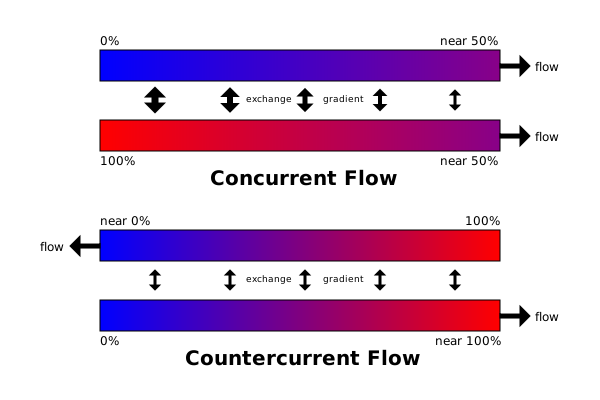
A diagram illustrating the difference between concurrent flow and countercurrent flow, the mechanism used in the rete mirabile to conserve heat. Joe (last name not listed), Public domain, via Wikimedia Commons.
However, the seemingly static evolutionary state of the louvar for many millions of years might raise more questions than this study has answered. Arostegui and colleagues presented three hypotheses:
- The state of internalized red muscle combined with ectothermy may have evolved before the species emerged, indicating no further evolution of this trait will occur in the species.
- Louvar are in the middle of an “evolutionary thrust”, which may eventually lead to endothermy in descendants of the modern species. This hypothesis is supported by the idea that the evolution of red muscle endothermy is tied to pelagic swimming mechanics. However, given that the most recent common ancestor of the modern, regionally-endothermic tuna emerged 40 million years ago, this would be a very slow evolutionary thrust.
- Due to adaptive tradeoffs, louvar may simply not be able to evolve endothermy. Opposing selective pressures may restrict evolutionary progress within the species. Endothermy has a higher metabolic cost than ectothermy. Given the louvar’s diet of low-calorie, slow-moving gelatinous plankton, there may not be an advantage for the organism to further develop endothermy. Regionally-endothermic, pelagic fish do not consume similar, gelativorous diets, while the ocean sunfish, also an ectotherm with internalized red muscle and no known retia, does. While the whole-body endotherm Lampris incognitus (Smalleye Pacific Opah – read more here!) also consumes gelatinous plankton in spite of its high metabolism, it is one of many prey items that the species dines on.

A photo of a louvar published in the 1913 publication Game Fishes of the World. University of Washington, Public domain, via Wikimedia Commons.
Fisheries:
Louvar are not frequently caught in fisheries, and are not specifically targeted by fishing efforts. Due to their preferences for gelatinous prey, as well as their lack of association with the seafloor, they are only caught as bycatch in drift gillnet fisheries in the United States, outside of very isolated cases.
However, management efforts have severely limited drift gillnet fisheries. As a result, the body of fisheries-dependent data regarding rarely-encountered species like louvar will likely diminish in future years.
Despite early 20th century fascination with the louvar among scientists, existing information surrounding this enigmatic species is extremely limited.
With the current trajectory of fisheries management, it seems that this strange, metallic fish may continue its mysterious life in the open oceans, mostly unknown to humankind.
Pin this post to read later!


_-.jpeg)